United Kingdom · CAP Code 3.7 · pre-publish checklist
Clinically proven and green claims checklist
Practical pre-publish checklist for UK landing pages: what evidence to hold before you put "clinically proven", "dermatologist tested", "eco-friendly", or "carbon neutral" live. CAP Code 3.7 literacy — not ASA clearance and not legal advice.
Why these two claim families matter
Clinically proven and environmental claims sit high on the ASA complaint list. Both require objective evidence before publish under CAP Code Rule 3.7 (substantiation). Both attract scrutiny from consumers, competitors, and prescribed bodies. This checklist is a plain reading of what "hold evidence before" typically means — not clearance for your specific claim.
Clinically proven claims checklist
Common claim patterns: "clinically proven", "dermatologist tested", "clinically tested", "proven to reduce wrinkles by X%", "medically approved", "tested by doctors". For No.1 dermatologist recommended badges and professional endorsement ribbons — a different evidence and signposting problem — see the sibling guide “Dermatologist recommended” and professional badges.
Before you publish
-
Do you hold the trial data? A clinical claim usually requires a clinical trial — human participants, documented methodology, measurable outcomes. You must hold the study report (or at least a summary sufficient to substantiate the claim) before the landing page goes live.
-
Does the trial match the claim? If you claim "clinically proven to reduce wrinkles by 50% in four weeks", the study must test wrinkle reduction, measure the same percentage, and use the same timescale. Close is not enough.
-
Was it tested on the product you are selling? A trial on a different formulation, a prototype, or a competitor's product does not substantiate your current SKU. Same active ingredient is not automatic clearance if the formulation or concentration differs.
-
Is the trial robust and independent? CAP and the ASA expect rigorous methodology: adequate sample size, control group where appropriate, peer review or independent oversight where claimed. An in-house survey of 10 staff is not "clinically proven".
-
Is the claim qualified on the page? If the trial had conditions (e.g. "when used twice daily for eight weeks"), those must appear on the landing page — not buried in small print, visible at first read.
-
Can you produce the evidence on request? The ASA can ask for substantiation at any time. If you cannot produce the study report, the claim fails even if the trial once existed.
For context, see CAP guidance on Rule 3.7 (Substantiation) and Section 3 (Misleading advertising). The ASA publishes adjudications — read recent skincare and supplement rulings to see how claims are tested.
Environmental (green) claims checklist
Common claim patterns: "eco-friendly", "carbon neutral", "100% recyclable", "sustainably sourced", "plastic-free", "biodegradable", "net zero", "compostable".
Before you publish
-
What does the claim actually mean? "Eco-friendly" is vague. If you claim it, be ready to define it and prove the definition. The ASA expects clear, specific claims: "100% recyclable via household kerb-side collection in England" is better than "recyclable".
-
Do you hold lifecycle evidence? Green claims often require full-lifecycle thinking. Claiming "carbon neutral" typically means you can document emissions across production, transport, use, and disposal — and show how offsets or reductions were achieved.
-
Is the claim absolute or qualified? "Plastic-free" means no plastic at all — including laminate, tape, and window film. If you mean "plastic-free bottle, but the lid is not", say so on the page. Omitting qualifications is misleading.
-
Can consumers act on it? Claiming "100% recyclable" when most UK councils do not accept that material type is misleading even if technically recyclable somewhere. State the practical limitation.
-
Are you using recognised standards? Third-party certification (e.g. FSC, Soil Association Organic, Carbon Trust Standard) strengthens your case. If you claim a standard, hold the certificate and state the certifying body.
-
Is it a comparative or absolute claim? "Greener than our old formula" needs evidence of the comparison. "Green" on its own is an absolute claim and harder to substantiate. Be clear which you mean.
-
Does the visual match the claim? Green leaves, earth imagery, and "eco" badges are advertising claims even if no text appears. If the image suggests environmental benefit, you must hold evidence for that suggestion.
For context, see the ASA guidance on environmental claims and the CMA Green Claims Code. Both describe substantiation expectations. The ASA has upheld many complaints where green claims were vague, unqualified, or unsupported — read the published rulings for patterns.
What CiteBefore does with these claim families
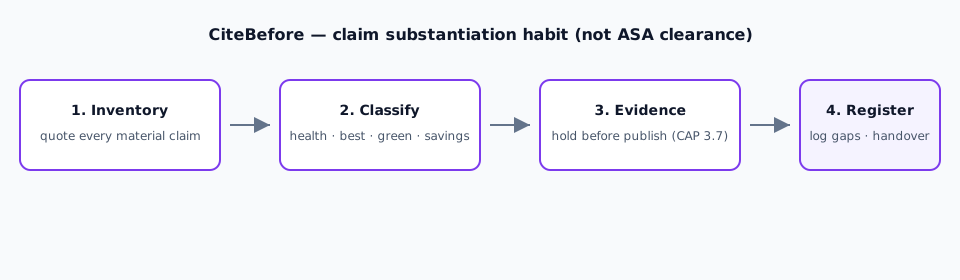
On the £29 Register, we inventory every clinically proven and green claim visible on your URL — hero, badge, bullet, footer — and create an evidence column for each. We flag superlatives and absolutes. We do not decide whether your evidence is adequate; that is the ASA's role. We organise the claim set so you can see what must be substantiated before publish.
Questions
Is holding the evidence the same as ASA clearance?
No. Holding robust evidence before publish meets CAP Code 3.7, but the ASA decides complaints case-by-case. Evidence that looks adequate to you may not satisfy the ASA if the claim is ambiguous, the trial flawed, or the qualification missing. CiteBefore inventories claims; we do not clear them.
Can I claim "eco-friendly" if my competitor does?
No. Competitor behaviour is not substantiation. If your competitor's claim is vague or unsupported, they risk an ASA complaint. Do not copy weak claims — build your own evidence base and claim only what you can prove.
Does "dermatologist tested" need a clinical trial?
Typically yes, if you imply efficacy or safety. "Dermatologist tested" suggests a meaningful evaluation by a qualified professional. A one-off patch test by one dermatologist is weaker than a formal trial. The ASA judges the impression the claim creates; hold evidence that matches that impression. For dermatologist recommended / No.1 ranking badges, see the professional-badges guide (survey evidence and verification signposting).
Is this legal advice or ASA clearance?
No. This guide and the £29 Register are claim-inventory tools. The ASA decides complaints. If you need clearance or legal advice, use ASA Copy Advice or instruct a solicitor.
Who runs CiteBefore?
Ellis Greensitt, sole trader, trading as CiteBefore. English law. See terms and privacy. Email hello@citebefore.co.uk. No telephone.
Informational guide only. Sources: CAP Code (Rules 3.1, 3.7, 11); ASA environmental claims guidance; CMA Green Claims Code. Last reviewed 8 September 2026. CiteBefore is not the ASA. See also countdown timers in UK ads for urgency-module literacy on retail pages.