United Kingdom · CAP Code 3.7 · beauty & professional badges
“Dermatologist recommended” and No.1 professional badges: evidence vs signposting
Beauty account leads ship hero badges — “No.1 dermatologist recommended”, “dermatologist tested”, professional endorsement ribbons — faster than anyone files the survey pack and the verification path. For dermatologist recommended advertising UK pages, CAP requires both: hold documentary evidence before publish, and signpost how consumers can check a comparative badge. This guide is literacy from public ASA materials — not clearance of any named brand and not legal advice.
This guide is distinct from the clinically proven and green claims checklist, which focuses on trial endpoints for efficacy language. “Dermatologist recommended” and “No.1 dermatologist recommended” are usually professional-survey or recommendation-ranking claims. Different evidence file — same pre-publish substantiation habit under rule 3.7, plus verifiability rules when the badge compares you to identifiable competitors (rule 3.35).
What consumers likely read
Rule 3.7 of the CAP Code requires marketers to hold documentary evidence before publication for objective claims consumers are likely to regard as capable of substantiation. CAP’s substantiation AdviceOnline stresses that the ASA looks at likely interpretation, not private intention.
On a product detail page, lines such as “dermatologist recommended”, “No.1 dermatologist recommended brand in the UK”, or “dermatologist tested” are often read as objective — either a ranking against other brands or a meaningful professional evaluation. That triggers two register columns:
- Evidence — the survey, test protocol, or trial that matches the claim as consumers will read it.
- Verification / signposting — for comparative “No.1” badges, how a consumer can check the comparison on the page itself (rule 3.35; see comparisons: identifiable competitors).
Public case study: L'Oréal UK Ltd t/a La Roche-Posay (A24-1265913)
The following is drawn from the published ASA ruling (17 September 2025). It is included as a public teaching example only — not a comment on any CiteBefore customer and not clearance guidance for La Roche-Posay or any other brand.
What the ad said
A La Roche-Posay product listing on laroche-posay.co.uk included carousel imagery with “N1 DERMATOLOGIST RECOMMENDED BRAND IN THE UK*”. The product description and footer repeated No.1 dermatologist recommended language, with footnotes referencing consultant dermatologist surveys (2023 and 2024 waves). A “for more info visit” link in the footer led, via further pages, to a PDF claim report.
What the ASA decided — three issues
- “A new mode of action like never before” — Not upheld. The ASA was satisfied that, as consumers would interpret it, the breakthrough claim about Melasyl’s mode of action was adequately substantiated.
- “No.1 dermatologist recommended brand in the UK” — substantiation — Not upheld on substantiation. The advertiser provided dermatologist barometer survey data (including sample sizes of 73 and 78 consultant dermatologists, independent agency conduct, and spontaneous recommendation questions). The ASA concluded the comparative claim was adequately substantiated and not misleading on that point.
- Same No.1 claim — verifiability — Upheld. Although substantiation was accepted, the ASA found the ad did not adequately signpost consumers to where they could verify the comparison. The hero carousel badge was not clearly connected to the survey footnote in the product description; footer signposting appeared only after scrolling past reviews; “for more info visit” was not explicit enough; and verification material related to the 2024 survey while some on-page claims referenced 2023 data. The ad breached rule 3.35 (comparisons with identifiable competitors).
Lesson for landing-page teams: holding the survey is necessary but not sufficient for a hero “No.1 dermatologist recommended” badge. Put the verification path next to the claim — explicit wording such as “to verify this claim, click here” and a ranking table consumers can reach without hunting through footer copy — and keep the verification data aligned with the survey year referenced on-page.
Trade and law-firm commentary on the same ruling appears in public notes from firms such as Mishcon de Reya and Clifford Chance, and from the CTPA — useful context for beauty compliance leads, but not a substitute for reading the ASA ruling itself.
Register rows for professional badges
-
Inventory every badge and variant — hero, carousel, pack shot, footer, schema text. “Dermatologist tested” and “No.1 dermatologist recommended” are separate rows if both appear.
-
Match evidence type to claim — recommendation survey for “recommended” / “No.1”; test or trial pack for “tested” or implied efficacy. See the clinical checklist for trial-style “clinically proven” lines.
-
Record survey metadata — agency, field dates, n, question wording, category definition, and whether the claim is spontaneous or prompted.
-
Signpost verification on-page — for comparative No.1 badges, note whether rule 3.35 is met beside the claim, not only in a distant footer. Merely listing a website address without stating it is where consumers verify the comparison is unlikely to be enough (per the ruling’s reading of rule 3.35).
“Dermatologist tested” vs “dermatologist recommended”
Account teams often treat these as interchangeable badge language. Consumers may not:
- Dermatologist recommended / No.1 dermatologist recommended — typically a comparative ranking or professional endorsement frequency claim. Expect survey evidence and verifiability for “No.1” wording.
- Dermatologist tested — often read as evidence of evaluation or efficacy. A one-off professional review is weaker than a formal test that matches the on-page promise. Hold evidence that fits the impression the line creates.
Do not use client testimonials or review widgets as the professional evidence file — see the sibling guide Testimonials are not substantiation.
What CiteBefore does — and does not do
Clear limits
- Not ASA clearance and not a substitute for ASA Copy Advice.
- Not legal advice and not clearance of any named brand mentioned in public rulings.
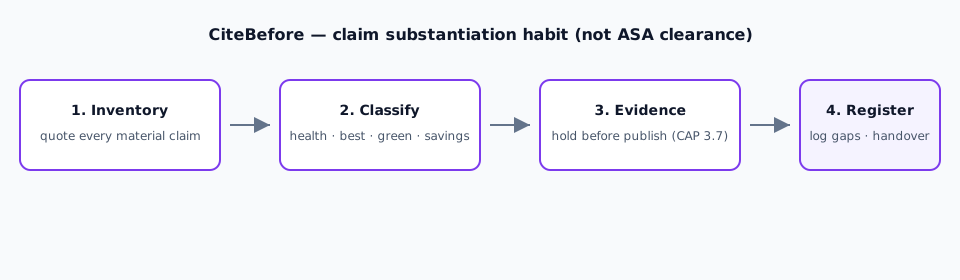
- CiteBefore inventories claims and suggests evidence columns to hold. The ASA decides complaints.
Try free scan See £29 Register sample Pricing
Primary sources
- ASA ruling: L'Oréal (UK) Ltd t/a La Roche-Posay (A24-1265913, 17 September 2025)
- ASA/CAP AdviceOnline: Substantiation
- Comparisons: identifiable competitors (rule 3.35 verifiability)
- Substantiation for health, beauty and slimming claims
- CAP Code Section 03 — Misleading advertising (rules 3.7, 3.33–3.35)
FAQ
What does “dermatologist recommended” mean in UK advertising?
Consumers often read it as a comparative claim — that dermatologists recommend the brand more than rivals. That needs documentary survey or trial evidence held before publish under CAP Code 3.7, plus clear signposting so consumers can verify the comparison under rule 3.35 where the badge is comparative.
Is holding the survey enough if the badge is in the hero?
Not always. In ASA ruling A24-1265913 (17 September 2025), substantiation for the No.1 dermatologist recommended claim was accepted, but the ad still breached rule 3.35 because verification was not clearly signposted next to the hero badge.
How is this different from “clinically proven”?
Clinically proven usually implies trial evidence on efficacy endpoints. Dermatologist recommended or No.1 dermatologist recommended is typically a professional survey or recommendation ranking — different evidence type, same pre-publish substantiation duty. Use the clinical checklist for trial-style claims; use this guide for professional badge and ranking language.
Does CiteBefore clear professional badges with the ASA?
No. CiteBefore inventories claims and evidence columns on a live URL. It is not ASA clearance, not Copy Advice, and not legal advice. It is not clearance of any named brand cited as a public example.
Related guides
- Clinically proven and green claims checklist
- Testimonials are not substantiation
- Advertising claim substantiation for UK landing pages
- Superlatives and “best” claims — CAP Rule 3.7
- CiteBefore vs ASA Copy Advice
Guide for UK marketers and agencies. Informational only. Author: Ellis Greensitt. datePublished 2026-09-09. Last reviewed against ASA ruling A24-1265913 and AdviceOnline substantiation materials as of Sep 2026. Not clearance of any named brand.