United Kingdom · CAP Code 8.17 · urgency & promotions
Countdown timers in UK ads — reading CAP cues (literacy)
E-commerce teams add ticking clocks to hero banners, sticky headers, cart drawers, and checkout nudges because urgency converts. For countdown timer advertising UK pages, published CAP and ASA materials treat a clock as a consumer cue: shoppers often read it as a genuine, time-limited offer that will end when the timer reaches zero. This guide is literacy on how to read those cues for a claim register — not ASA clearance, not legal advice, and not a complaint coach.
Where countdown and urgency timers appear
Countdown clocks sit in the online choice architecture of many UK retail and D2C sites. Common placements:
- Site-wide sticky banners — “HURRY! FREE DELIVERY ENDS IN 00:12:34” above every product page.
- PDP price modules — a timer paired with a struck-through “was” price and a promotional “now” price.
- Cart and checkout — “Your discount expires in…” beside the order total.
- Pop-ups and slide-ins — email-capture or exit-intent overlays with a ticking offer (inventory the promotional claim inside the overlay, not only the timer).
- Non-promotional deadlines — delivery-time countdowns (“arrives in 1 hour”) or stock-hold timers; different consumer expectation, still a timed promise on the page.
Marketers use timers to signal scarcity and speed purchase decisions. CAP’s published materials note that incorporating a countdown brings consumer expectations about how long an offer remains available (ASA: It’s the final countdown, but is it really?).
What published CAP / ASA materials say about urgency
These are themes from AdviceOnline and ASA news — literacy only, not a ruling on your live URL.
Significant conditions and closing dates (rule 8.17)
CAP Code section 8 requires promotions to communicate significant conditions where omission would mislead. A prominent closing date is listed as a significant condition (rule 8.17.4.a). AdviceOnline on promotional marketing closing dates explains that most promotions need a closing date, and that closing dates must be presented clearly and prominently.
Rule 8.17.4.e states that closing dates must not be changed unless unavoidable circumstances outside the promoter’s control apply, and the change would not disadvantage those who participated on the original terms. CAP’s countdown guidance ties this to clocks that restart when they reach zero — treating a reset as changing a closing date outside permitted circumstances.
Countdown clocks and genuine time-limited offers
ASA news articles The final countdown and It’s the final countdown, but is it really? summarise CAP’s position:
- Promotions tied to a countdown should be genuine — any accompanying discount should be a genuine saving against the price at which the item is usually sold.
- Consumers who buy during the countdown often do so in good faith that the deal is time-limited; published materials say prices should revert to the non-promotional level when the period ends.
- A clock should not restart for the same offer once it finishes — that is presented as inconsistent with rule 8.17.4.e.
- Words like “HURRY” alongside a timer can reinforce the impression that the offer is time-limited (closing dates AdviceOnline cites Boohoo.com UK Ltd, 6 May 2020, as an example in published materials).
Published ASA case summaries in AdviceOnline also illustrate how consumers may read a timer next to a struck-through reference price as meaning the discount will end and the product will return to the usual selling price — for example materials referencing Wowcher Ltd (1 July 2019) and Online Home Retail Ltd / Wood Burner World (18 June 2017). This guide does not treat those as legal holdings on your page; they show how the ASA has discussed likely interpretation in published records.
Link to savings claims
When a timer sits beside a “was/now” module, read both together. CAP’s promotional savings claims AdviceOnline requires reference prices to represent a genuine established usual selling price (rule 3.39). A countdown can imply the promotional price is temporary — pair timer literacy with the was/now pricing guide when inventorying retail PDPs.
How to read a timer claim for a CiteBefore claim register
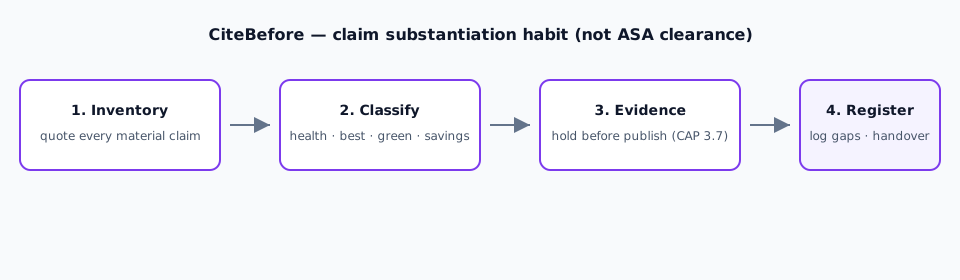
When you paste a URL into CiteBefore or build a manual register row, capture the timer as its own claim — not as decoration:
-
Copy the exact timer text — including “HURRY”, “ENDS IN”, red styling notes if material, and the paired promotional line (e.g. “FREE DELIVERY”, “30% OFF”, “Price guaranteed for”).
-
Write the likely consumer takeaway — e.g. “Offer ends when clock reaches zero; price or benefit reverts afterward.”
-
Note the promotion mechanics — scheduled end date/time, whether the SKU returns to a higher price, whether the clock resets, and which sales channel the offer applies to.
-
Cross-link savings rows — if a struck-through “was” price appears above the timer, log a separate reference-pricing row and tie it to the same promotion window.
-
Mark evidence held or gap — promotion brief, pricing history, post-countdown price plan. CiteBefore suggests evidence columns; your team holds the files.
Example register thinking (illustrative, not clearance):
- Claim: “ENDS IN 02:14:33 — 20% off everything” → Takeaway: site-wide time-limited discount → Evidence to note: promotion start/end, post-promo price list, rule 8.17 significant conditions on the page.
- Claim: “Arrives in 60 minutes” with live clock → Takeaway: delivery-time promise → Evidence to note: delivery substantiation file, not promotion closing-date file.
The agency claim-register template shows column layout. A free scan surfaces urgency-shaped lines; the £29 Claim Register is the file-ready PDF for client handover.
What CiteBefore does — and does not do
Clear limits
- Not ASA clearance and not a substitute for ASA Copy Advice.
- Not legal advice and not confirmation that a timer module is cleared to publish.
- Not a complaint coach — we do not tell you to report an ad to the ASA or assert that a live timer is a “breach”.
- CiteBefore inventories claims and suggests evidence columns to hold. The ASA decides complaints against the CAP Code.
Free on-screen scan · £29 PDF Claim Register · £79/mo Site Watch · £149/mo Agency
Try free scan Order £29 Register Pricing
Primary sources
- ASA: It’s the final countdown, but is it really?
- ASA: The final countdown
- ASA/CAP AdviceOnline: Promotional marketing — closing dates
- ASA/CAP AdviceOnline: Promotional savings claims
- CAP Code Section 08 — Sales promotions (rules 8.17, 8.17.4.e)
- CAP Code Section 03 — Misleading advertising (rule 3.1)
FAQ
Does a countdown timer always mean the offer must end?
Published ASA materials say consumers often read a promotional countdown as time-limited and expect the benefit or price to end when the clock reaches zero. CAP’s closing-date guidance and countdown news articles stress genuine time limits and not restarting the same offer. Context matters; this guide does not adjudicate your live page.
Should I log the timer separately from the discount line?
Yes. The discount percentage and the timer create different consumer takeaways. Log each material line on the register, then tie related rows in your Evidence notes.
Does CiteBefore clear countdown copy with the ASA?
No. CiteBefore inventories claims and evidence columns on a live URL. It is not ASA clearance, not Copy Advice, and not legal advice. The ASA decides complaints.
What about delivery-time countdowns?
Those are timed performance claims, not promotional closing dates. Inventory them under delivery substantiation, not promotion rule 8.17 — see claim substantiation for performance-class habits.
Related guides
- Advertising claim substantiation for UK landing pages
- Was/now pricing claims (incl. Black Friday) — reading UK CAP cues
- Free delivery advertising claims under UK CAP — landing-page literacy
- Clinically proven and green claims checklist
- How to build a CAP-style claim register (agency template)
- All guides
Guide for UK marketers and agencies. Informational only. Author: Ellis Greensitt. datePublished 2026-09-09. Last reviewed against ASA countdown and promotional-marketing materials as of Sep 2026.