United Kingdom · CAP Code 3.7 · landing pages
Before-and-after URLs: why re-scan the same claim after a landing-page edit
The path can stay identical — /offers, /product, or a campaign landing — while the claims consumers read change overnight. A claim register tied to “that URL, last month” goes stale the moment hero, badge, or savings copy ships. This guide is a practical before-and-after inventory habit for the same live URL — not ASA clearance.
Agencies often file one register at first publish and treat the URL as “done”. Growth, CRM, and seasonal teams then edit the same page without reopening the inventory. Under CAP Code rule 3.7, what matters is the marketing communication as it stands when consumers see it — not the version you inventoried three sprints ago. Below is how to treat edits as a before-and-after re-scan, with primary CAP/ASA sources.
Same URL, different claim set
Rule 3.7 of the CAP Code (Misleading advertising — Substantiation) requires marketers to hold documentary evidence before distributing or submitting a marketing communication for publication, for claims consumers are likely to regard as objective and capable of substantiation. CAP’s AdviceOnline note on substantiation stresses likely interpretation and evidence held before go-live.
A CMS save on an existing path is still publication of whatever claims now appear. Practical consequences for registers:
- A new headline can introduce an objective claim that was never on the first inventory.
- Softening one line while hardening a badge can move risk without anyone updating the Evidence column.
- Recycled modules (email capture, footer trust strip, “as featured in”) often ship outside the original hero review.
- Dated savings or ranking lines can keep the same wording while the underlying evidence pack expires.
So “we already scanned https://example.com/landing” is not the same as “the live claim set matches the register on file.”
Edits that usually stale a register
Do not wait for a new URL. Re-open the inventory when any of these ship on the live page:
- Hero / H1 / subhead rewrites (“best”, “leading”, “clinically proven”, absolute green lines).
- New or swapped trust badges, award ribbons, certification marks, or climate logos.
- Savings percentages, “from £…”, comparison tables, or performance stats.
- Feature grids and FAQ answers that quietly restate efficacy or superiority claims.
- Footer, sticky bar, and modal copy that reuse claims legal thought were only in the hero.
If the edit is typography-only and the claim wording is byte-identical, still spot-check badges and modules — they are the usual silent drift. For claim-class evidence maps, see Advertising claim substantiation for UK landing pages; for superlative spotting, see Superlatives and “best” claims.
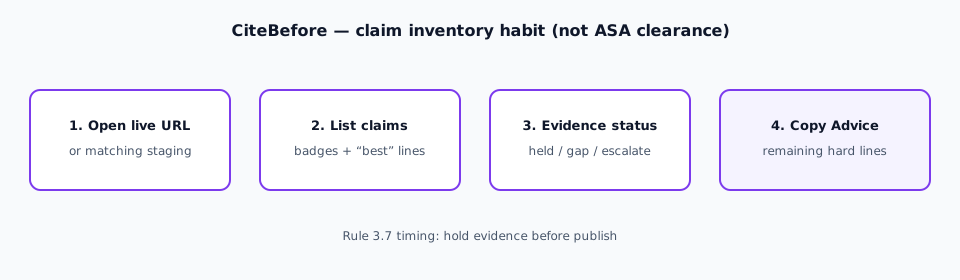
A before-and-after re-scan habit
-
Before the edit ships — archive the live URL (PDF or dated HTML capture), the current register version, and who owns evidence. Note planned claim changes in plain English.
-
Ship the edit on staging that matches go-live, then on the live URL. Record publish time and ticket/PR reference on the register cover.
-
After: re-inventory the same URL top to bottom. Add new rows, mark removed claims as retired (do not silently delete history), and flag wording that hardened or lost a qualifier.
-
Reconcile evidence — held / gap / Copy Advice candidate for every material row that changed. Close gaps or soften copy before traffic scales. Escalate contested lines to ASA Copy Advice or a solicitor when interpretation is the issue — inventory alone is not clearance.
What to keep on the register cover
Make the before/after trail obvious to the next agency or in-house owner:
- Canonical URL (path + query if claims differ by parameter).
- Inventory date and previous inventory date (the “before”).
- Edit summary in one sentence (“hero + badge strip refreshed for spring sale”).
- Evidence owners and any open gaps carried forward.
That cover line is what stops a six-month-old PDF being treated as proof that today’s page was inventoried.
What CiteBefore does — and does not do
Clear limits
- Not ASA clearance and not a substitute for ASA Copy Advice.
- Not legal advice and not confirmation that an edited claim is cleared to stay live.
- CiteBefore inventories claims on a live URL and suggests evidence columns to hold. Re-scanning after an edit keeps the inventory current; the ASA decides complaints against the CAP Code.
Use a free after-pass when you need a quick risk shortlist, or a fresh £29 register when the client handover folder must match the live page. Clearance decisions stay with you and your advisers.
Try free scan Claim-register template Vs ASA Copy Advice
Primary sources
- CAP Code Section 03 — Misleading advertising (includes rule 3.7)
- ASA/CAP AdviceOnline: Substantiation
- ASA: Substantiation 101
- Types of claims: general · Comparisons: general
- ASA Copy Advice
FAQ
If the URL did not change, do I still need a new claim inventory?
Often yes. CAP Code rule 3.7 looks at the marketing communication as consumers see it. A landing-page edit can add, harden, or relocate objective claims even when the path stays the same. Treat a material copy change as a fresh inventory moment.
Does a re-scan mean CiteBefore cleared the page with the ASA?
No. CiteBefore inventories claims and evidence columns on a live URL. It is not ASA clearance, not Copy Advice, and not legal advice. Re-scanning keeps the register current; the ASA decides complaints. See CiteBefore vs ASA Copy Advice.
What edits usually break an old claim register?
Hero and subhead rewrites, new trust badges or award ribbons, savings or percentage lines, comparative tables, green or climate badges, recycled email-module claims, and footer trust strips. Any of these can change the claim set consumers actually see.
What should I do first after a rushed go-live edit?
Capture the live URL, re-inventory every material claim (including badges), mark evidence held or gap, then close gaps or soften copy. A free scan is a fast after-pass; the £29 register is the file-ready refresh for the client folder.
Related guides
- Advertising claim substantiation for UK landing pages
- How to build a CAP-style claim register (agency template)
- Superlatives and “best” claims — CAP Rule 3.7
- CiteBefore vs ASA Copy Advice
Guide for UK marketers and agencies. Informational only. Author: Ellis Greensitt. datePublished 2026-09-07. Last reviewed against ASA AdviceOnline substantiation materials as of Sep 2026.