United Kingdom · agencies · CAP claim inventory
How to build a CAP-style claim register for a client landing page (agency template)
UK agencies shipping client landing pages need a repeatable advertising claim register — a CAP-style claim inventory that lists every material line, the evidence to hold, and a short note against the Code — before go-live. This is a practical template: intake → columns → Evidence / CAP-style notes → client handover folder.
Performance teams often treat “claim register” as a spreadsheet habit. For UK paid and organic landing pages it should mean a CAP-style advertising claim register: documentary evidence held before publication under CAP Code rule 3.7. Pair this template with advertising claim substantiation for UK landing pages (what evidence to hold by claim class). Use CiteBefore’s free scan for a quick triage, or the £29 Claim Register PDF when you need the full inventory with Evidence and CAP-style note columns — see the Register sample.
Why agencies need a CAP-style advertising claim register
Client pages accumulate objective-sounding lines across headlines, hero bullets, badges, comparison tables, and footer trust strips. Under rule 3.7, marketers must hold documentary evidence to prove claims that consumers are likely to regard as objective and that are capable of objective substantiation — before distributing or submitting the marketing communication for publication. CAP’s AdviceOnline note on substantiation and the ASA’s Substantiation 101 brief both stress the same operational point: build the claim around evidence you already hold; reverse-engineering a study after launch can still leave a 3.7 problem.
An agency-owned CAP claim inventory template does three jobs the Slack thread cannot:
- It forces a full pass of the live URL, not only the lines legal already flagged.
- It separates what the page says from what evidence sits in the client’s folder.
- It creates a dated handover artefact the client can file — without implying ASA clearance.
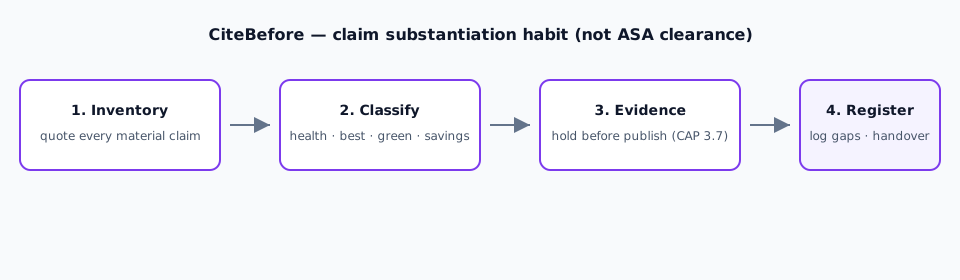
Agency workflow: intake → inventory → notes → handover
-
Intake — Capture the live URL, client legal entity, publish date (or planned go-live), product category, and who owns evidence (client brand, agency, or third-party lab). Note any claims the brief already treats as “must keep”.
-
Inventory — Walk the page top to bottom. Log every material claim as a row: headline, subheads, bullets, badges, stats, comparisons, endorsements, green/climate lines, savings percentages. Ignore nothing a consumer could treat as a fact.
-
Classify and risk-flag — Tag class (health/clinical, comparative/best, green/climate, savings/stats, endorsement, other) and a provisional High / Medium / Lower risk based on claim strength and category friction. For evidence expectations by class, see the substantiation guide.
-
Evidence and CAP-style notes — For each row, record what documentary evidence should be on file, or mark a gap. Add a short CAP-style note pointing at the relevant Code theme (e.g. substantiation 3.7, comparisons 3.33–3.34, testimonials 3.47–3.49) — not a clearance opinion.
-
Client handover folder — Export or PDF the register, attach evidence files (or links to the client’s vault), and store under a dated path the account team can reopen if ASA, a platform, or the client’s counsel asks. Rule 3.7 is about holding evidence before publication and being able to produce it without delay.
Inventory columns (agency template)
Keep the sheet boring and consistent. A workable CAP-style advertising claim register for agencies usually includes:
| Column | What to capture |
|---|---|
| Claim text | Exact wording as it appears on the page (quote the line). |
| Location | Hero, bullet list, badge, table cell, footer, etc. |
| Likely takeaway | Plain-English reading a consumer is likely to take (not the brief’s intent). |
| Claim class | Health/clinical, comparative/best, green/climate, savings/stats, endorsement, other. |
| Risk | High / Medium / Lower — triage for account and legal, not a verdict. |
| Evidence to hold | Study pack, certificate, market data, price capture, permission trail — or “gap”. |
| CAP-style note | Short pointer to Code theme / AdviceOnline topic; no “cleared” language. |
| Owner / status | Who must supply the file; open / attached / softened in copy. |
CiteBefore’s paid Claim Register maps to the core of this layout: Claim · Risk · Evidence to hold · CAP-style note, with a cover (URL, date, reference) so the PDF files cleanly in a client folder. Compare the illustrative layout on the £29 Register sample.
Free scan vs £29 Claim Register — column split
Agencies often start with a free pass, then upgrade when the client needs a file-ready inventory. The product split is deliberate:
| Feature | Free scan | £29 Claim Register |
|---|---|---|
| Format | On-screen only | Printable PDF for one URL |
| Coverage | Top ~5 highest-risk flags | Full material-claim inventory |
| Columns | Claim + short Risk | Claim · Risk · Evidence · CAP-style note |
| Cover sheet | No | URL, date, reference |
| Best for | Quick triage / pitch support | Client handover folder / pre-publish file |
Run a free scan when you need a fast High-risk shortlist. Order the £29 Claim Register when account management needs every material claim with Evidence and CAP-style notes in one PDF. Side-by-side samples: free-scan sample and Register sample.
What to put in the client handover folder
A useful handover is small and dated — not a dump of every brand asset:
- The CAP-style advertising claim register (PDF or sheet) for the specific live URL and scan date.
- Evidence files or vault links keyed to each row (protocol, certificate, price captures, permission emails).
- A short open-gaps list: claims still live without evidence, or copy softened pending data.
- A one-line disclaimer that the pack is an informational inventory, not ASA clearance and not legal advice.
Hold evidence commensurate with the claim as consumers are likely to understand it — CAP’s substantiation materials are clear that intention does not override likely interpretation, and that objective claims need objective evidence (AdviceOnline: Substantiation). For health, beauty and slimming efficacy, see also substantiation for health, beauty and slimming claims. For comparisons, read Comparisons: general alongside Code rules 3.32–3.39.
Common agency pitfalls on UK landing pages
Three patterns show up repeatedly when agencies build a CAP-style claim inventory under deadline:
- Inventorying only the briefed lines. Rule 3.7 applies to the marketing communication as consumers see it — including badges, comparison tables, and recycled trust strips the creative deck never listed.
- Treating testimonials as efficacy evidence. Genuine testimonials may appear, but CAP advises they alone are unlikely to substantiate objective claims; factual lines inside a quote still need objective support (substantiation advice; Code rules 3.47–3.49). See Testimonials are not substantiation.
- Filing the register after launch. Holding evidence that only appears after the claim goes live can still breach 3.7 even if the claim is later shown to be true. Build the advertising claim register into the pre-publish gate, not the post-mortem.
What CiteBefore does — and does not do
Clear limits
- Not ASA clearance and not a substitute for ASA Copy Advice.
- Not legal advice and not confirmation that a claim is “cleared” to publish.
- CiteBefore inventories claims and suggests evidence columns to hold. The ASA decides complaints against the CAP Code.
Use the free scan and £29 Register as pre-flight tools inside your agency process — intake, inventory, notes, handover — not as a rubber stamp. Clearance decisions stay with the client and their advisers. More on how CiteBefore works and pricing.
Try free scan See £29 Register sample Pricing
Primary sources
- CAP Code Section 03 — Misleading advertising (includes rule 3.7 substantiation; comparisons; testimonials)
- ASA/CAP AdviceOnline: Substantiation
- ASA: Substantiation 101
- Substantiation for health, beauty and slimming claims
- Comparisons: general · Types of claims: general
- ASA Copy Advice
- CiteBefore guide: Advertising claim substantiation for UK landing pages
FAQ
Is a CAP-style advertising claim register the same as ASA clearance?
No. A register inventories claims, risk flags, and evidence to hold. It does not clear copy. The ASA decides complaints; Copy Advice is a separate ASA service. CiteBefore is informational only — not ASA clearance and not legal advice.
When should an agency use the free scan vs the £29 Claim Register?
Use the free scan for a quick on-screen shortlist (top ~5 Claim + Risk flags). Use the £29 Claim Register when you need a full inventory with Evidence and CAP-style note columns as a printable PDF for the client handover folder. Compare free sample and Register sample.
What columns should our agency template include?
At minimum: claim text, location, likely consumer takeaway, claim class, risk, evidence to hold, CAP-style note, and owner/status. That mirrors the paid Register’s Claim · Risk · Evidence · CAP note core and keeps food/NHC “claim register” ambiguity out of your process by framing it as a CAP advertising claim inventory.
Do we need evidence before the client page goes live?
Yes for objective claims capable of substantiation. CAP Code 3.7 requires documentary evidence to be held before distributing or submitting the marketing communication for publication. See also what evidence to hold by claim class.
Can we say the register means CAP or ASA endorsed the page?
No. Do not imply ASA or CAP endorsement. Rule 3.51 restricts referring to CAP advice or implying ASA/CAP endorsement in marketing communications. Keep handover language as inventory and evidence prompts only.
Related guides
- Advertising claim substantiation for UK landing pages
- Agency claim substantiation handoff
- Health claims on product detail pages
- How to build a CAP-style claim register (agency template)
- Superlatives and “best” claims — CAP Rule 3.7
- Before-and-after URLs: re-scan after a landing-page edit
- Countdown timers in UK ads — reading CAP cues (literacy)
- Was/now pricing claims (incl. Black Friday) — reading UK CAP cues
- CiteBefore vs ASA Copy Advice
Guide for UK agencies and in-house marketing teams. Informational only. Last reviewed against ASA/CAP substantiation materials as of Sep 2026.