United Kingdom · CAP Code 3.7 · landing pages
Superlatives and “best” claims — logging CAP Rule 3.7 risk on a live URL
“Best”, “leading”, “No.1”, and “#1” lines convert. They also concentrate CAP Code rule 3.7 risk, because consumers often read them as objective superiority claims that need documentary evidence held before the page goes live. This guide is a practical inventory habit for logging those lines on one live URL — not ASA clearance.
Most landing pages ship superlatives faster than anyone files the evidence pack. Hero lines, trust badges, comparison tables, and recycled agency headlines all look like conversion copy — and many can be treated as objective claims capable of substantiation. Below is a working habit for catching them on a live URL, with primary CAP/ASA sources.
What CAP Code 3.7 means for “best” and “leading”
Rule 3.7 of the CAP Code (Misleading advertising — Substantiation) states that before distributing or submitting a marketing communication for publication, marketers must hold documentary evidence to prove claims that consumers are likely to regard as objective and that are capable of objective substantiation. The ASA may regard claims as misleading in the absence of adequate substantiation.
CAP’s AdviceOnline note on substantiation is explicit that objective comparisons such as “leading”, “best”, or “cheaper” need evidence relating to your product and the competitors in scope. Related AdviceOnline notes on leading claims, types of claims: general, and comparisons: general matter on landing pages:
- Unqualified “leading” is often understood as best-selling (unit sales and/or market share) unless the ad makes another meaning clear.
- “Best”, “No.1”, and “#1” are frequently treated as objective superiority claims when tied to performance, market position, or an implied industry-wide ranking.
- The ASA looks at the likely interpretation of the line, not the marketer’s private intention that it was “just puffery”.
- Evidence must be held before go-live. Building the claim around available market data is safer than reverse-engineering a ranking after launch.
Obvious exaggerations and clear statements of opinion can fall outside 3.7 where they are unlikely to be taken literally (see rules 3.2 and 3.6 in the same Code section). On a product or service landing page, that exception is narrower than many teams assume — especially for badge strips and “UK’s leading…” footers.
Where superlatives hide on a live URL
Do not stop at the H1. Walk the page top to bottom and log every line a consumer could treat as a ranking or superiority fact:
- Hero headlines and subheads (“The UK’s best…”, “No.1 for…”).
- Bullet lists and feature grids that recycle “leading technology / best-in-class” phrasing.
- Trust badges, award ribbons, and “as featured in” strips that imply a ranked position without a dated source.
- Comparison tables and pricing cards that imply you beat “the market” or unnamed rivals.
- Footer trust lines, schema-style review snippets, and email capture modules that reuse the same superlative.
If the same “best” claim appears three times, log three rows or one row with locations noted — but do not silently drop badge copy because “legal already saw the hero”.
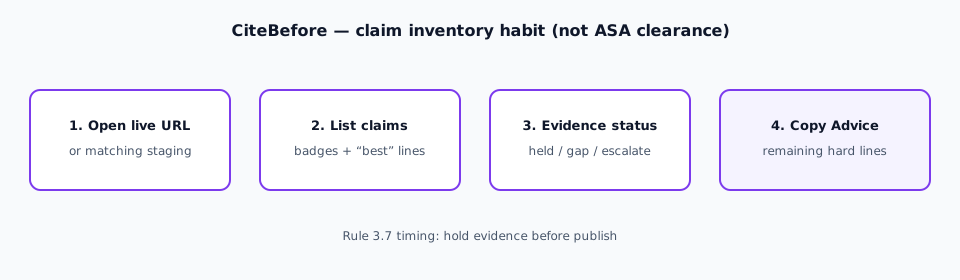
A practical inventory habit (four passes)
-
Open the live URL (or staging that matches go-live copy). Capture the URL, publish or planned go-live date, and who owns evidence.
-
List every material claim, then flag each best / leading / No.1 / #1 / top / unmatched line as a superlative or comparative row — including badges and recycled headlines.
-
Define the comparison set in writing for each flagged row (UK market? category? timeframe? named rivals?). Note the likely consumer takeaway in plain English (“we sell more than anyone else in X” vs “we think our design is nicer”).
-
Mark evidence status — held / gap / Copy Advice candidate. Close gaps or soften copy before publish. Only then escalate contested lines to ASA Copy Advice or a solicitor. See when inventory stops and Copy Advice starts.
Evidence that usually matters for superlatives
One size does not fit all. Match the evidence to the likely reading of the claim:
- Best-selling / leading-as-sales — contemporaneous unit-sales or market-share data covering the comparison set you implied, not a cherry-picked shortlist.
- Best performance / best technology — tests or third-party data that match the endpoint, product, and population on the page.
- No.1 / #1 rankings — the ranking source, date, category definition, and geography — held before go-live.
- Price / “cheaper than the best” — dated competitor price captures and like-for-like product definitions.
For the wider claim-class map (health, green, savings, as well as comparative/best), use the sibling guide Advertising claim substantiation for UK landing pages.
What CiteBefore does — and does not do
Clear limits
- Not ASA clearance and not a substitute for ASA Copy Advice.
- Not legal advice and not confirmation that a “best” claim is cleared to publish.
- CiteBefore inventories claims and suggests evidence columns to hold. The ASA decides complaints against the CAP Code.
Use the product as a pre-flight checklist when agencies and in-house teams ship pages faster than legal can review every superlative. Clearance decisions stay with you and your advisers.
Try free scan Claim-register template Vs ASA Copy Advice
Primary sources
- CAP Code Section 03 — Misleading advertising (includes rule 3.7)
- ASA/CAP AdviceOnline: Substantiation
- Types of claims: leading · Types of claims: general
- Comparisons: general · Comparisons: identifiable competitors
- Puffery and expressions of opinion
FAQ
Is “best” always an objective claim under CAP?
Often yes when consumers are likely to treat it as a measurable superiority claim. CAP AdviceOnline on substantiation and on leading / best-type claims treats many unqualified superlatives as objective comparisons that need documentary evidence under rule 3.7. Context matters; the ASA looks at likely interpretation, not the marketer’s private intention.
Does CiteBefore clear best claims with the ASA?
No. CiteBefore inventories claims and evidence columns on a live URL. It is not ASA clearance, not Copy Advice, and not legal advice. See CiteBefore vs ASA Copy Advice for when each is useful.
What should I do first when the page is full of “leading” badges?
Inventory every material superlative and comparative on the live URL, mark evidence held or gap, then close gaps or soften copy before publish. A free scan is a quick triage; the claim-register template and £29 register are the file-ready habit. Pair with the substantiation guide for evidence by claim class.
Who writes these CiteBefore guides?
Ellis Greensitt, sole trader, trading as CiteBefore. English law. See terms and privacy. Email hello@citebefore.co.uk. No telephone.
Related guides
- Advertising claim substantiation for UK landing pages
- How to build a CAP-style claim register (agency template)
- Before-and-after URLs: re-scan after a landing-page edit
- Was/now pricing claims (incl. Black Friday) — reading UK CAP cues
- CiteBefore vs ASA Copy Advice
Guide for UK marketers and agencies. Informational only. Author: Ellis Greensitt. datePublished 2026-09-05. Last reviewed against ASA AdviceOnline substantiation and leading-claims materials as of Sep 2026.