United Kingdom · CAP Code 3.7 · landing pages
Advertising claim substantiation for UK landing pages: what evidence to hold before you publish
If a consumer is likely to read a line on your page as an objective fact, you should already hold the documentary evidence that supports it. That is the core of advertising claim substantiation UK practice under CAP Code 3.7 — and it applies to live marketing URLs as much as to press ads.
Most landing pages ship claims faster than anyone files the evidence pack. Efficacy lines, “best”, climate badges, and savings percentages all look like conversion copy — and all can be treated as objective claims that need substantiation before publication. Below is a practical map of what to hold, by claim class, with primary CAP/ASA sources.
What CAP Code 3.7 actually requires
Rule 3.7 of the CAP Code (Misleading advertising — Substantiation) states that before distributing or submitting a marketing communication for publication, marketers must hold documentary evidence to prove claims that consumers are likely to regard as objective and that are capable of objective substantiation. The ASA may regard claims as misleading in the absence of adequate substantiation.
CAP’s AdviceOnline note on substantiation (updated 12 Mar 2026) stresses three points that matter on landing pages:
- The ASA looks at the likely interpretation of a claim, not the marketer’s private intention. A line meant as puffery can still be treated as objective.
- Objective claims need objective evidence. Self-reported consumer sentiment alone is usually not enough for efficacy or performance claims.
- Evidence must be held before the claim goes live. Building the claim around available evidence is safer than reverse-engineering a study after launch.
Obvious exaggerations and clear statements of opinion can fall outside 3.7 where they are unlikely to be taken literally (see rules 3.2 and 3.6 in the same Code section). On a product or service landing page, that exception is narrower than many teams assume — especially for “best”, “proven”, percentages, and environmental absolutes.
Evidence checklist by claim class
One size does not fit all. The level of evidence should match the strength of the claim and the category. Use this as a pre-publish checklist — not as clearance.
Health, clinical, and beauty efficacy
Medical and scientific claims about health and beauty products, weight control, food supplements, and cosmetics are expected to be backed by relevant evidence — often trials on human subjects where the Code sector rules apply. See CAP’s substantiation overview and the dedicated AdviceOnline on substantiation for health, beauty and slimming claims.
- Hold the full study pack: protocol or method, sample size (n), endpoints, statistical analysis, and a clear link to the same product (or formulation) you sell.
- Match the ad claim to the result. “Clinically proven to reduce X in Y weeks” needs evidence for that endpoint, population, and timeframe — not a related biomarker or a different SKU.
- Testimonials and star ratings do not replace objective efficacy evidence. CAP is clear that genuine testimonials are allowed, but alone they are unlikely to substantiate objective claims (substantiation advice). See the dedicated guide Testimonials are not substantiation for the register habit on review widgets.
- Breakthrough or absolute claims need a higher bar: a body of robust data, not a single small study.
Comparative, “best”, and “leading”
Comparisons can be explicit (“beats Brand X”) or implicit (“the best on the market”). Objective comparisons such as “leading”, “best”, or “cheaper” need evidence covering your product and the competitors in scope. See Comparisons: general, Comparisons: identifiable competitors, and Types of claims: general.
- Define the comparison set in writing (UK market? category? timeframe?) and keep the data that covers that set — not a cherry-picked shortlist.
- Compare products meeting the same need or purpose, on material, relevant, verifiable features (CAP rules 3.33–3.34).
- For “best technology / best available / #1”, hold contemporaneous market evidence. Partial competitor samples often fail when the claim reads as industry-wide.
- Price and “cheaper” claims need dated competitor price captures and like-for-like product definitions.
Green, climate, and environmental claims
Environmental claims are high friction on UK landing pages: certification badges, “climate positive”, “net zero”, “eco”, and packaging lines are routinely read as objective. Hold scheme documentation and scope notes, and read CAP’s Advertising Guidance on misleading environmental claims and social responsibility alongside the general substantiation rules.
- Name the certification scheme, standard, and certificate (or membership) that is current for the claim period.
- Document scope: product, company, or campaign? UK operations or global? Which emissions scopes?
- Separate reduction from offsetting. If the page says “climate positive” or “carbon neutral”, hold the calculation method, baseline, and offset or reduction evidence that matches the wording.
- Avoid absolute “toxin-free / plastic-free / zero impact” language unless you can substantiate the absolute reading consumers are likely to take.
Savings, percentages, and stats
Price statements, “save X%”, “X% improvement”, and performance stats are classic objective claims. CAP’s substantiation advice lists price statements and benefit/effect claims among examples that need supporting evidence.
- Hold the calculation: base price or baseline metric, sample, date range, and exclusions.
- Ensure the published percentage matches the evidence (same population, same product, same period).
- Qualify averages and ranges on-page where the raw figure would otherwise overclaim.
- Keep screenshots or exports of source systems (pricing CMS, analytics, lab reports) dated before go-live.
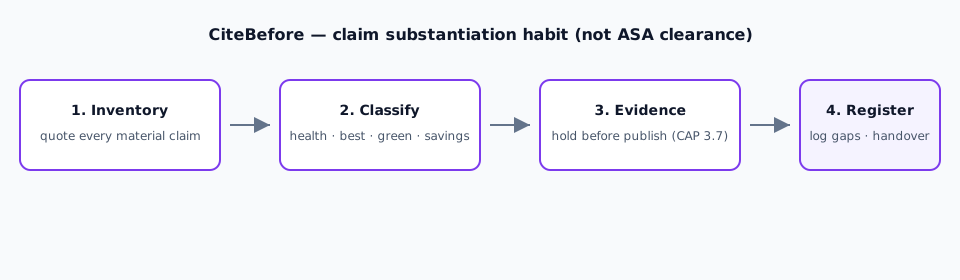
A pre-publish substantiation workflow
-
Inventory every material claim on the URL — headlines, bullets, badges, footer trust lines, and comparison tables. Ignore nothing that a consumer could treat as a fact.
-
Classify each row (health/clinical, comparative/best, green/climate, savings/stats, or other) and note the likely consumer takeaway in plain English.
-
Attach evidence (study, certificate, market data, price capture) or mark a gap. Do not publish the claim until the gap is closed or the copy is softened to a non-objective reading.
-
File before ship. Store the pack so you can produce it without delay if ASA or a platform asks. Rule 3.7 is about holding evidence before publication.
If you want a structured starting inventory for one live URL, run a free on-screen scan (top risk flags) or order the £29 Claim Register (full inventory with Evidence and CAP-style note columns). See the free-scan sample and Register sample side by side.
What CiteBefore does — and does not do
Clear limits
- Not ASA clearance and not a substitute for ASA Copy Advice.
- Not legal advice and not confirmation that a claim is “cleared” to publish.
- CiteBefore inventories claims and suggests evidence columns to hold. The ASA decides complaints against the CAP Code.
Use the product as a pre-flight checklist for agencies and in-house teams shipping health, beauty, green, home-services, or B2B pages faster than legal can review every line. Clearance decisions stay with you and your advisers. More on how CiteBefore works and pricing.
Try free scan See £29 Register sample Pricing
Primary sources
- CAP Code Section 03 — Misleading advertising (includes rule 3.7)
- ASA/CAP AdviceOnline: Substantiation
- Substantiation for health, beauty and slimming claims
- Comparisons: general · Types of claims: general
- Advertising Guidance: misleading environmental claims and social responsibility
- Non-broadcast Advertising Code hub
FAQ
Do I need evidence before the page goes live?
Yes for objective claims capable of substantiation. CAP Code 3.7 requires marketers to hold documentary evidence before distributing or submitting the marketing communication for publication. Holding a study that only appears after launch can still leave a 3.7 problem even if the claim is later shown to be true.
Is a customer testimonial enough for a “clinically proven” claim?
Usually no. Genuine testimonials may appear in ads, but CAP advises they alone are unlikely to substantiate objective efficacy claims. Hold appropriate study evidence for the claim as consumers will read it.
Does CiteBefore clear my copy with the ASA?
No. CiteBefore is an informational claim inventory with CAP-style risk flags and evidence prompts. It is not ASA clearance, not Copy Advice, and not legal advice. The ASA decides.
What should I do first on a busy landing page?
Inventory material claims, triage the highest-risk classes (health/clinical, comparative/best, green/climate, savings/stats), and attach or commission evidence before publish. A free scan is a quick starting list; the £29 register is the file-ready full inventory.
Related guides
- Advertising claim substantiation for UK landing pages
- Testimonials are not substantiation
- “Dermatologist recommended” and professional badges
- How to build a CAP-style claim register (agency template)
- Agency claim substantiation handoff
- Health claims on product detail pages
- Superlatives and “best” claims — CAP Rule 3.7
- Before-and-after URLs: re-scan after a landing-page edit
- Countdown timers in UK ads — reading CAP cues (literacy)
- Was/now pricing claims (incl. Black Friday) — reading UK CAP cues
- Free delivery advertising claims under UK CAP — landing-page literacy
- Money-back guarantee claims on landing pages — CAP literacy
- CiteBefore vs ASA Copy Advice
Guide for UK marketers and agencies. Informational only. Last reviewed against ASA AdviceOnline substantiation materials as of Sep 2026.