United Kingdom · agencies · CAP Code 3.7
Agency claim substantiation handoff — CAP 3.7 literacy
When a UK agency ships a client landing page, agency advertising claim substantiation is an operational handoff — not a legal retainer and not ASA clearance. Under CAP Code rule 3.7, documentary evidence for objective claims must be held before publication. This guide covers who inventories what, how to separate the live URL from the client brief, and how a dated claim register becomes the handover artefact — without implying CiteBefore replaces counsel or Copy Advice.
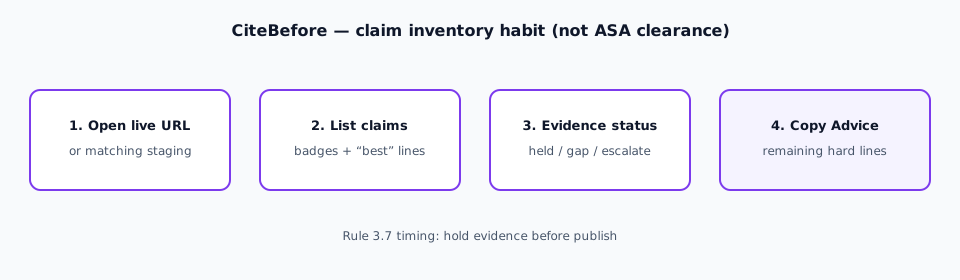
Why agencies need a substantiation handoff — not just creative sign-off
Account and performance teams often treat “legal approved the deck” as done. Live client URLs accumulate claims from CRM modules, merchandising feeds, and last-minute hero swaps that never passed the same review. CAP’s AdviceOnline on substantiation and rule 3.7 focus on the marketing communication consumers see — and on evidence held before it publishes.
An agency substantiation handoff does four jobs a Slack thread cannot:
- Separates copy intent from live URL reality — the brief said “leading provider”; the page says “No.1 in the UK”.
- Names evidence owners — client product team, agency studio, third-party research vendor, or gap.
- Dates the inventory — so a six-month-old PDF is not mistaken for today’s claim set. See Before-and-after URL re-scan.
- Documents gaps without pretending clearance — “Evidence: gap — client to supply trial pack by [date]” is honest; “Looks fine” is not a register row.
This guide pairs with the column layout in How to build a CAP-style claim register (agency template). That template shows what to file; this guide shows when and who in the agency workflow.
Who holds substantiation — agency, client, or both?
CAP addresses the marketer — typically the client whose product or service is advertised. Agencies still need a defensible workflow because they often draft, build, or publish the page. Practical literacy split:
- Client (marketer) — ultimate responsibility for holding documentary evidence before publication; ASA enquiries usually land here first.
- Agency — duty to inventory what went live, flag gaps before publish, and hand over a dated register — not to invent studies or assert clearance.
- Freelance copy / dev contractors — claims they add in CMS or component libraries must appear on the same register; do not assume the account lead saw the footer trust strip.
CiteBefore does not allocate legal liability between parties. It gives agencies a repeatable inventory pass on the live URL before handover.
Agency substantiation workflow: brief → staging → live → handover
-
Intake the client brief and any evidence pack — studies, certificates, competitor data, pricing history. Log what arrived, what is missing, and who owns follow-up. Do not treat “client says it’s proven” as a substantiation row.
-
Inventory staging that matches go-live — hero, badges, comparison tables, FAQs, footer strips. Paste the staging URL into a free scan for a quick risk shortlist.
-
Reconcile brief vs page — every objective line on staging gets Claim · Takeaway · Evidence held/gap · CAP note. Escalate health, comparative, and green classes using advertising claim substantiation and sector guides (e.g. health claims on PDPs).
-
Publish gate — do not ship material rows with open evidence gaps unless the client explicitly accepts softened copy or commissions evidence on a documented timeline. Inventory is not clearance; it makes gaps visible.
-
Handover folder — dated register PDF, live URL, evidence index (or gap list), and re-scan trigger for the next edit. The £29 Claim Register is the file-ready layout; Register sample shows client-facing format.
-
Post-launch re-scan — client or growth team edits the same URL without telling the agency. Re-inventory after material edits; Site Watch (£79/mo) automates weekly re-crawl for retained clients.
Common agency failure patterns
- Brief-only review — legal saw a Word doc; merchandising pushed different stats on the live PDP.
- Component drift — reusable hero, badge, and testimonial modules carry old claims from a previous client vertical.
- “Client approved the copy” — approval is not documentary evidence under rule 3.7.
- Retainer without re-scan — seasonal swaps change claims; the register dated at kick-off is stale by month two.
- Confusing inventory with Copy Advice — a gap list tells you what to hold; ASA Copy Advice or counsel addresses contested interpretation. See CiteBefore vs ASA Copy Advice.
What to put in the handover memo (one page)
Keep it factual — no clearance language:
- Canonical live URL and inventory date.
- Register version (free-scan triage vs £29 full register).
- Evidence rows marked held — with file names or client contact, not the files themselves unless contracted.
- Open gaps — claim text, owner, target date, interim copy softening if any.
- Next re-scan trigger (“after Black Friday hero swap”, “when PDP bundle tile updates”).
What CiteBefore does — and does not do
Clear limits
- Not ASA clearance and not a substitute for ASA Copy Advice.
- Not legal advice and not allocation of liability between agency and client.
- Not a substitute for counsel — contract terms, indemnities, and regulatory interpretation stay with qualified advisers.
- CiteBefore inventories claims on a live URL and suggests evidence columns. The ASA decides complaints against the CAP Code.
Free on-screen scan · £29 PDF Claim Register · £79/mo Site Watch · £149/mo Agency
Try free scan See Register sample Claim-register template
Primary sources
- CAP Code Section 03 — Misleading advertising (includes rule 3.7)
- ASA/CAP AdviceOnline: Substantiation
- ASA: Substantiation 101
- ASA Copy Advice
FAQ
Is the agency or the client responsible for CAP 3.7 substantiation?
CAP addresses the marketer — usually the client. Agencies still need a workflow to inventory live claims, flag gaps before publish, and hand over a dated register. Contract terms may allocate tasks differently; this guide does not provide legal advice on liability.
Does a claim register count as substantiation?
No. A register lists claims and whether evidence is held or missing. Substantiation means holding the underlying documentary evidence before publication — studies, certificates, market data — not the inventory spreadsheet itself.
When should an agency re-scan a client URL?
After any material copy change on the live page — hero, badges, savings lines, comparison tables, PDP modules — even when the URL path stays the same. See Before-and-after URL re-scan.
Does CiteBefore replace legal or ASA Copy Advice for agency clients?
No. CiteBefore inventories claims and evidence columns. It is not ASA clearance, not Copy Advice, and not legal advice. Use Copy Advice or counsel when interpretation is contested.
Related guides
- How to build a CAP-style claim register (agency template)
- Advertising claim substantiation for UK landing pages
- Before-and-after URLs: re-scan after a landing-page edit
- Health claims on product detail pages
- CiteBefore vs ASA Copy Advice
- All guides
Guide for UK marketers and agencies. Informational only. Author: Ellis Greensitt. datePublished 2026-09-16. Last reviewed against ASA substantiation AdviceOnline as of Sep 2026.