United Kingdom · CAP Code 3.7 · product detail pages
Health claims on product detail pages — CAP 3.7 literacy
Supplements, skincare, haircare, and wellness PDPs stack health claims product detail page copy in places conversion teams rarely audit as a set — title tags, benefit bullets, ingredient panels, before/after captions, and review widgets. Published CAP and ASA materials treat many of those lines as objective efficacy claims that need substantiation before the PDP goes live under rule 3.7. This guide is PDP inventory habit — not ASA clearance, not legal advice, and not product-formulation advice.
Where health claims hide on a PDP
Product detail pages look like catalogue content. Under CAP, many modules are still marketing communications. Common PDP placements to inventory as separate claim rows:
- Product title and H1 — “Joint support complex”, “Acne-clearing serum”, “Metabolism booster” can read as health outcomes, not just category labels.
- Benefit bullets and “key benefits” — “Reduces visible wrinkles in 4 weeks”, “Supports immune function”, “Clinically proven to…” beside the add-to-basket button.
- Ingredient and “active” callouts — “Contains 500mg turmeric — anti-inflammatory”, “Probiotic strains shown to improve gut health” (efficacy implied by dose or naming).
- Before/after imagery and captions — photo pairs with “Results after 28 days” or “93% saw improvement” in the caption (inventory the caption text, not only the image).
- Stats and chart modules — “87% reduction in redness”, “2× faster recovery” without a visible study citation on-page.
- Review and UGC widgets — star ratings are one thing; quoted lines inside reviews that restate efficacy (“cleared my eczema”) are objective claims in context. See Testimonials are not substantiation.
- Badges and trust strips — “Dermatologist tested”, “Clinically proven”, “No.1 for sensitive skin”. Pair with “Dermatologist recommended” badges and the clinically proven checklist.
- Cross-sell and bundle tiles — related SKU cards that repeat efficacy lines the main PDP no longer carries.
PDPs also sit in a wider path: paid social and email often crop one bullet while the live URL carries ten. Inventory the canonical PDP URL consumers land on after the click.
What published CAP / ASA materials say about health PDP claims
These are literacy themes from AdviceOnline and published ASA records — not a ruling on your live page.
Substantiation before publish (rule 3.7)
CAP Code rule 3.7 requires marketers to hold documentary evidence before distributing or submitting a marketing communication for publication, for claims consumers are likely to regard as objective and capable of substantiation. CAP’s AdviceOnline on substantiation and substantiation for health, beauty and slimming claims stress:
- Likely interpretation — the ASA assesses how the average consumer reads the PDP line, not the formulator’s private intent.
- Objective evidence for objective claims — self-reported sentiment or testimonials alone are unlikely to substantiate efficacy claims.
- Evidence before go-live — commissioning a study after the PDP ships can still leave a 3.7 gap even if results later support the line.
- Match claim to evidence — “Reduces wrinkles in 4 weeks” needs evidence for that endpoint, population, and timeframe on the same product (or formulation) sold on the PDP.
Medical and reduction-of-risk claims
Stronger health claims — treating, preventing, or diagnosing disease — sit under dedicated CAP sections and sector rules. PDP copy that names conditions (“treats psoriasis”, “prevents heart disease”) triggers a higher substantiation and qualification bar than general wellness puff. This guide does not provide medical-claims clearance; inventory the exact wording and escalate interpretation questions to ASA Copy Advice or qualified advisers.
Before/after photos on PDPs
Published ASA materials on before/after imagery discuss whether photos are representative, retouched, or tied to atypical results. For register literacy: log the caption, any “results may vary” qualifier, and whether the visual implies a measurable outcome. This is separate from the operational habit of re-scanning the same URL after a landing-page edit — here the focus is the claim inside the photo module on the PDP itself.
How to read a PDP for a CiteBefore claim register
-
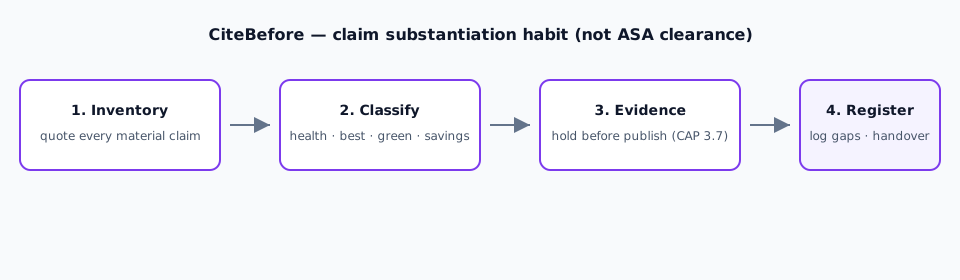
Paste the live PDP URL — include variant parameters if claims differ by SKU or locale.
-
Inventory every efficacy-shaped line — title, bullets, long description, FAQs, accordion “How it works”, ingredient blurbs, captions.
-
Classify the claim — general wellness vs measurable efficacy vs comparative/superlative. Tag superlatives separately; see Superlatives and “best” claims.
-
Write the consumer takeaway — plain English (“This serum removes acne in 2 weeks”) separate from marketing shorthand.
-
Mark evidence held or gap — study pack, certificate, in-vitro vs in-vivo scope, SKU match. Do not publish the line until the gap closes or copy softens.
-
Re-scan after PDP edits — CMS refreshes, seasonal bundles, and A/B hero swaps change the claim set without a new URL. See Before-and-after URL re-scan.
Example register thinking (illustrative, not clearance):
- Claim: “Clinically proven to reduce fine lines in 28 days” → Takeaway: measurable anti-ageing efficacy on humans → Evidence to note: full trial pack for this SKU, n, endpoints, stats → CAP note: rule 3.7 health/beauty substantiation.
- Claim: “Customers love how fast it works” → Takeaway: subjective opinion unless paired with a stat → Risk note: adjacent bullet says “works in 3 days” — inventory both rows.
The agency claim-register template shows column layout. For claim-class evidence maps across the whole site, see Advertising claim substantiation for UK landing pages.
What CiteBefore does — and does not do
Clear limits
- Not ASA clearance and not a substitute for ASA Copy Advice.
- Not legal advice and not confirmation that a PDP health line is cleared to publish.
- Not a complaint coach — we do not tell you to report an ad to the ASA.
- CiteBefore inventories claims and suggests evidence columns to hold. The ASA decides complaints against the CAP Code.
Free on-screen scan · £29 PDF Claim Register · £79/mo Site Watch · £149/mo Agency
Try free scan See free-scan sample Order £29 Register
Primary sources
- CAP Code Section 03 — Misleading advertising (includes rule 3.7)
- ASA/CAP AdviceOnline: Substantiation
- Substantiation for health, beauty and slimming claims
- ASA: Substantiation 101
- ASA Copy Advice
FAQ
Do health claims on a PDP need evidence before the page goes live?
Often yes for objective efficacy claims. CAP Code rule 3.7 requires documentary evidence before publication for claims consumers are likely to regard as objective and capable of substantiation. PDP benefit bullets and stats are commonly read that way.
Is an ingredient list enough substantiation for a benefit bullet?
Usually no on its own. Naming an ingredient does not automatically prove the outcome stated in the adjacent bullet (“supports joint health”, “boosts collagen”). Hold evidence that matches the claim as consumers read it, or soften the line.
Should I inventory review-widget quotes on the PDP?
Inventory objective-sounding lines inside quoted reviews when they restate efficacy the brand highlights (“cleared my acne in a week”). Testimonials alone are unlikely to substantiate objective claims — see Testimonials are not substantiation.
Does CiteBefore clear PDP health copy with the ASA?
No. CiteBefore inventories claims and evidence columns on a live URL. It is not ASA clearance, not Copy Advice, and not legal advice. The ASA decides complaints.
Related guides
- Advertising claim substantiation for UK landing pages
- Clinically proven and green claims checklist
- Testimonials are not substantiation
- “Dermatologist recommended” and professional badges
- Before-and-after URLs: re-scan after a landing-page edit
- How to build a CAP-style claim register (agency template)
- All guides
Guide for UK marketers and agencies. Informational only. Author: Ellis Greensitt. datePublished 2026-09-16. Last reviewed against ASA health/beauty substantiation AdviceOnline as of Sep 2026.