United Kingdom · CAP Code 3.7 · testimonials & reviews
Testimonials are not substantiation: logging review-widget claims on a UK landing page
Agencies often paste a Trustpilot strip or “clients say it works” module as if that were the study pack. CAP is explicit: genuine testimonials are allowed, but they alone do not prove an objective efficacy, savings, or performance claim. The habit that matters for testimonials substantiate claims UK practice is to inventory the claim inside the quote — not the star rating.
Review widgets convert. They also concentrate substantiation risk when the quoted text carries an objective promise — “cleared my skin in two weeks”, “saved me £200 on bills”, “better than surgery”. The Code applies to claims in testimonials the same way it applies to claims in your hero line (Claims in testimonials and endorsements, rules 3.48–3.49). Below is a practical register habit for UK landing pages — not clearance.
What CAP says: testimonials are not evidence
CAP’s AdviceOnline on claims in testimonials and endorsements states plainly that testimonials alone do not constitute substantiation, so marketers should not rely on testimonials as support for any direct or implied claims in the marketing communication.
The same point appears in the general substantiation AdviceOnline note: provided they are genuine, marketers may feature customer testimonials, but these alone are unlikely to be considered sufficient to substantiate objective claims. Any objective claims made in testimonials — such as those about efficacy — must be supported by sufficient objective evidence.
That is a different question from whether a testimonial is genuine (rules on testimonials and endorsements). You can have a real five-star review and still breach rule 3.7 if the quoted line makes an objective promise you cannot prove.
Public ASA examples: quotes are not the study pack
These are summarised from published ASA materials — not invented findings.
Halcyon Bracelets (February 2015)
As recorded in CAP’s substantiation AdviceOnline, an advertiser submitted testimonials in support of efficacy claims for a copper bracelet in the treatment of restless leg syndrome. The ASA ruled that personal or customer endorsement alone did not constitute adequate substantiation. The lesson for landing pages: a stack of genuine customer stories does not replace documentary evidence for a health or efficacy promise.
Lipstick Gangster Ltd t/a The Lipstick Gangster (12 July 2023)
In a published ruling, the ASA noted emails from two clients but concluded that testimonials were not adequate to substantiate claims about the efficacy of cosmetic treatments. Before-and-after photos in the same ad were also problematic where positioning and evidence did not support the implied result. CAP’s testimonials AdviceOnline cites this case alongside Halcyon Bracelets as a reminder that client emails are not a substitute for robust substantiation.
Bright Networks Ltd t/a Bright Heating (9 January 2013)
Customer survey responses with positive comments about saving money on energy bills were not considered adequate substantiation for savings claims — another illustration that sentiment data is not the same as proof of an objective savings promise (claims in testimonials).
Trustpilot widgets and “social proof” strips
Embedding a third-party review widget does not transfer the platform’s credibility to your substantiation file. Common landing-page patterns that still need a register row:
- Curated quote carousels — “This serum erased my dark spots in 10 days” selected from hundreds of reviews.
- Star-average badges — “4.9/5 on Trustpilot” next to a product efficacy line (the stars do not prove the efficacy line).
- “Clients say…” email snippets — forwarded client praise pasted into the body copy or a case-study block.
- UGC reposts — Instagram or TikTok quotes pulled into the page without separating subjective enthusiasm from measurable results.
Subjective praise (“great customer service”, “arrived quickly”) is a different risk profile from objective efficacy or savings language inside the same widget. Inventory both — but only the objective lines need a study pack, price-capture file, or trial report under rule 3.7.
Inventory the claim inside the quote
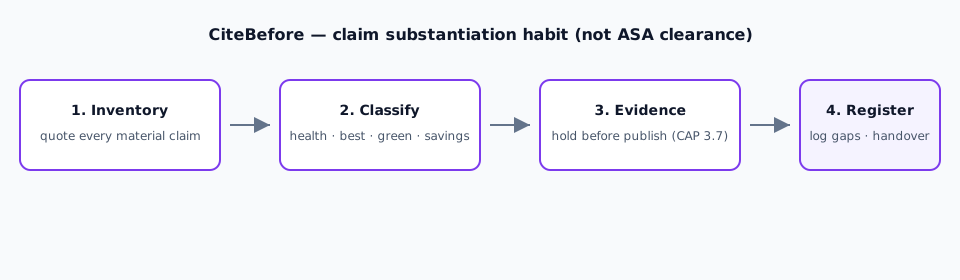
Do not log “Trustpilot widget — 4.8 stars” as one vague row. Split each material quoted line:
-
Copy the exact quote as it appears on the live URL — including ellipses, emphasis, and any headline you added above it.
-
Write the likely consumer takeaway in plain English. Would a reader treat this as “this product works for condition X” or merely “this person liked the brand”?
-
Classify objective vs subjective. If the takeaway is objective and capable of substantiation, mark the Evidence column — trial, test data, savings calculation — or mark a gap. Testimonials do not close the gap.
-
Fix before ship. Soften the quote, remove the objective line, or hold the documentary evidence that matches the claim as consumers will read it — held before publication per rule 3.7.
Example register thinking (illustrative, not clearance):
- Quote: “My energy bills dropped by 40% after installing this.” → Takeaway: measurable savings claim → Evidence needed: calculation, baseline, period — not the testimonial itself.
- Quote: “Lovely team, super fast delivery.” → Takeaway: subjective service praise → lower 3.7 friction if no implied performance guarantee elsewhere on the page.
How this differs from the substantiation pillar
The sibling guide Advertising claim substantiation for UK landing pages maps evidence by claim class (health, comparative, green, savings). This guide focuses on one agency habit: stopping review widgets from standing in for the evidence column. Pair them when you inventory a beauty or home-services URL with both clinical lines and a Trustpilot strip.
What CiteBefore does — and does not do
Clear limits
- Not ASA clearance and not a substitute for ASA Copy Advice.
- Not legal advice and not confirmation that a quoted line is cleared to publish.
- CiteBefore inventories claims and suggests evidence columns to hold. The ASA decides complaints against the CAP Code.
Try free scan See £29 Register sample Pricing
Primary sources
- ASA/CAP AdviceOnline: Claims in testimonials and endorsements
- ASA/CAP AdviceOnline: Substantiation (Halcyon Bracelets example)
- ASA ruling: Lipstick Gangster Ltd t/a The Lipstick Gangster (12 July 2023)
- CAP Code Section 03 — Misleading advertising (rules 3.7, 3.48–3.49)
- Testimonials and endorsements (genuineness rules)
FAQ
Can testimonials substantiate claims in UK advertising?
Genuine testimonials may appear in ads, but CAP AdviceOnline is clear that testimonials alone do not constitute substantiation for objective efficacy, savings, or performance claims. Hold documentary evidence for the claim as consumers will read it — not just the star rating or quote.
Does a Trustpilot widget count as evidence for a landing-page claim?
No for objective claims. A review widget can support subjective service praise, but if the quoted text implies efficacy, savings, or superiority, you still need objective evidence held before publish under CAP Code 3.7. Inventory the factual claim inside each quote.
What about “verified buyer” or “real customer” badges?
Verification speaks to genuineness, not substantiation. A verified purchase does not prove the product delivered the objective result stated in the quote. See testimonials and endorsements for genuineness; see claim substantiation for the evidence pack.
Does CiteBefore clear testimonial copy with the ASA?
No. CiteBefore inventories claims and evidence columns on a live URL. It is not ASA clearance, not Copy Advice, and not legal advice. The ASA decides complaints.
Related guides
- Advertising claim substantiation for UK landing pages
- “Dermatologist recommended” and professional badges
- How to build a CAP-style claim register (agency template)
- Clinically proven and green claims checklist
- CiteBefore vs ASA Copy Advice
Guide for UK marketers and agencies. Informational only. Author: Ellis Greensitt. datePublished 2026-09-09. Last reviewed against ASA AdviceOnline testimonials and substantiation materials as of Sep 2026.