United Kingdom · CAP Code 3.9 · delivery & shipping
Free delivery advertising claims under UK CAP — landing-page literacy
E-commerce hero banners, sticky headers, and checkout nudges often promise free delivery advertising claims UK shoppers can trust — “FREE UK DELIVERY”, “Free shipping on all orders”, “No delivery charge”. Published CAP and ASA materials treat absolute delivery claims as substantiation and qualification questions: when a buried geographic exclusion or minimum-order threshold contradicts the headline, rule 3.9 is the literacy frame. This guide is claim-register habit — not ASA clearance, not legal advice, and not logistics strategy.
Where free delivery claims appear
Delivery-benefit copy sits across the online purchase path. Common placements:
- Site-wide sticky banners — “FREE UK DELIVERY ON ALL ORDERS” above every product page (often paired with a countdown timer).
- PDP and category tiles — “Free delivery” badge beside price modules that may also carry was/now savings lines.
- Cart and checkout — “You qualify for free delivery” until a postcode reveals a surcharge.
- Email and paid social — cropped “free shipping” lines that deep-link to checkout (inventory the destination URL, not only the ad crop).
- Subscription or membership offers — “free delivery” bundled with an annual fee; published ASA materials discuss whether the delivery is genuinely “free” when an upfront payment applies.
Consumers often treat “free UK delivery” as meaning no delivery charge anywhere in the United Kingdom. Published ASA enforcement materials and case summaries discuss when a qualification buried in terms contradicts that takeaway.
What published CAP / ASA materials say about free delivery
These are themes from AdviceOnline and published ASA records — literacy only, not a ruling on your live URL.
Absolute claims and geographic exclusions (rule 3.9)
CAP Code section 3 requires ads not to mislead (rules 3.1, 3.3). Rule 3.9 states that qualifications must not contradict the claims they qualify.
Published ASA materials on delivery charges discuss patterns such as:
- Absolute “free delivery on all orders” — when Scottish Highlands, Northern Ireland, or other postcodes are excluded or surcharged, a headline that promises free delivery everywhere can be read as contradicting the buried exclusion (materials reference Ebuyer Ltd, 19 November 2014, as an example of an unqualified absolute claim with geographic restrictions).
- Qualified from the outset — copy such as “Free delivery to selected locations” or “Free delivery (exclusions apply — see below)” may be acceptable when the qualification does not contradict the headline and is presented clearly (materials discuss Roomstogo-style qualified wording as a contrast pattern).
- “Free” when a charge applies — promising free delivery while applying a delivery charge at checkout can mislead (materials reference Click Travel Ltd, 7 November 2018, as an example where a “free delivery” promise did not match checkout behaviour).
- “Free” with an upfront fee — “free delivery” tied to a paid subscription or annual membership may not be genuinely free if consumers must pay to access the benefit (materials reference MySale Ltd, 5 September 2018, as an example in published records).
This guide quotes published themes only. It does not treat ASA case summaries as legal holdings on your page.
Delivery charges stated upfront (rule 3.24.3)
AdviceOnline on compulsory costs and charges — delivery charges explains that non-optional delivery charges should be stated upfront where they apply. For claim-register literacy, pair the headline “free delivery” row with any checkout surcharge logic your team holds — not as consumer-contract advice, but as evidence that the live page matches the claim.
UK-wide delivery expectations
ASA enforcement notices on delivery claims have discussed that an unqualified “UK delivery” or “free UK delivery” claim can be read as covering mainland UK, islands, and Scottish Highlands unless clearly qualified from the outset. Crown Dependencies and other edge cases are fact-specific; this guide does not provide legal advice on territorial scope.
How to read a free delivery claim for a CiteBefore claim register
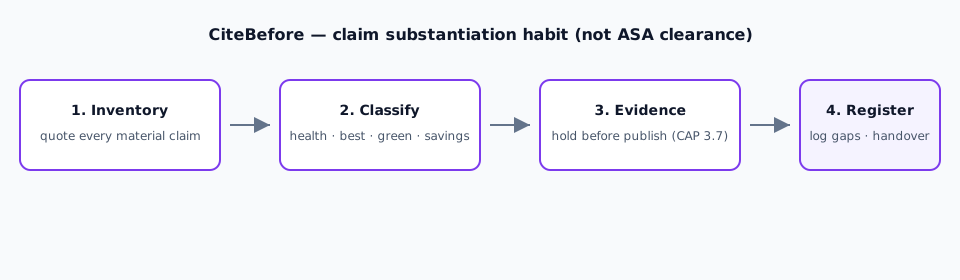
When you paste a URL into CiteBefore or build a manual register row, capture delivery copy as its own claim — not as design chrome:
-
Copy the exact delivery line — “FREE UK DELIVERY”, “Free shipping”, “No delivery charge”, including styling notes if “free” is the dominant visual.
-
Locate the qualification — T&Cs link, postcode checker, FAQ footnote, checkout tooltip. Note whether it is visible before purchase or only after postcode entry.
-
Write the likely consumer takeaway — e.g. “No delivery charge on any UK order” vs “Free to most UK postcodes; Highlands surcharged.”
-
Flag contradiction risk — if the headline is absolute and the qualification excludes regions or imposes a minimum order, note rule 3.9 in your CAP-style column.
-
Mark evidence held or gap — delivery-charge matrix, postcode-exclusion list, checkout QA screenshots. CiteBefore suggests evidence columns; your team holds the files.
Example register thinking (illustrative, not clearance):
- Claim: “FREE UK DELIVERY ON ALL ORDERS” → Takeaway: no delivery charge anywhere in UK → Risk note: Scottish Highlands £35 surcharge in checkout only → CAP note: rule 3.9 contradiction risk.
- Claim: “Free delivery on orders over £50” → Takeaway: conditional free delivery → Evidence to note: threshold stated in hero or only in T&Cs; rule 3.24.3 upfront-charge habit.
The agency claim-register template shows column layout. A free scan surfaces delivery-shaped lines; the £29 Claim Register is the file-ready PDF for client handover. Site Watch (£79/mo) re-scans checkout paths when seasonal delivery copy changes.
What CiteBefore does — and does not do
Clear limits
- Not ASA clearance and not a substitute for ASA Copy Advice.
- Not legal advice and not confirmation that a delivery module is cleared to publish.
- Not a complaint coach — we do not tell you to report an ad to the ASA or assert that a live “free delivery” line is a “breach”.
- CiteBefore inventories claims and suggests evidence columns to hold. The ASA decides complaints against the CAP Code.
Free on-screen scan · £29 PDF Claim Register · £79/mo Site Watch · £149/mo Agency
Try free scan Order £29 Register Pricing
Primary sources
- ASA/CAP AdviceOnline: Compulsory costs and charges — delivery charges
- CAP Code Section 03 — Misleading advertising (rules 3.1, 3.3, 3.9, 3.24.3)
- Non-broadcast Advertising Code hub
FAQ
Can I say “free UK delivery” if Scottish Highlands cost extra?
Published ASA materials discuss absolute “free UK delivery” headlines alongside geographic exclusions as a rule 3.9 contradiction risk when the qualification contradicts the headline. Safer patterns qualify from the outset — e.g. “Free delivery to most UK locations (exclusions apply)”. This guide does not adjudicate your live page; inventory the headline and the buried qualification together.
Should I log “free delivery” separately from a minimum-order threshold?
Yes. The threshold is a significant condition. Log the headline delivery claim and the order-minimum line (or footnote) as related rows, then tie them in your Evidence notes. See the register template.
Does a countdown timer change free-delivery literacy?
When “FREE DELIVERY ENDS IN…” sits on a timer, inventory both modules. Urgency copy can reinforce that delivery is genuinely time-limited — see the countdown timer guide.
Does CiteBefore clear free-delivery copy with the ASA?
No. CiteBefore inventories claims and evidence columns on a live URL. It is not ASA clearance, not Copy Advice, and not legal advice. The ASA decides complaints.
Related guides
- Advertising claim substantiation for UK landing pages
- Was/now pricing claims (incl. Black Friday) — reading UK CAP cues
- Countdown timers in UK ads — reading CAP cues (literacy)
- How to build a CAP-style claim register (agency template)
- All guides
Guide for UK marketers and agencies. Informational only. Author: Ellis Greensitt. datePublished 2026-09-14. Last reviewed against ASA delivery-charges AdviceOnline and published enforcement themes as of Sep 2026.