United Kingdom · CAP Code 3.39 · reference pricing
Was/now pricing claims (incl. Black Friday) — reading UK CAP cues
Retail PDPs, category pages, and seasonal email landers lean on strike-through “was £X” lines beside a bold “now £Y”. For was now pricing claims UK pages — including Black Friday and January sale modules — published CAP materials frame reference pricing as a substantiation question: does the higher price represent a genuine established usual selling price? This guide is literacy for your claim register — not ASA clearance, not legal advice, and not price-comparison legal advice.
Where was/now and strike-through pricing appear
Reference pricing modules are everywhere in UK e-commerce creative:
- Product detail pages — “Was £199.99 · Now £129.99 · Save £70” with optional RRP line.
- Category grids — “Up to 50% off” with per-SKU struck-through prices in tiles.
- Seasonal campaign landers — Black Friday, Cyber Monday, Boxing Day, and “January sale” hero blocks.
- Marketplace listings — third-party seller prices where the platform still displays the ad.
- Email and paid social — cropped was/now pairs that deep-link to the PDP (inventory the destination URL).
Consumers often treat a crossed-out “was” price as regulated and trustworthy. ASA research on reference pricing (cited in CAP’s updated materials) underpins why substantiation and duration discipline matter in published guidance.
How published ASA/CAP guidance frames reference pricing
These are themes from AdviceOnline: Promotional savings claims (updated May 2026) — literacy only.
Genuine usual selling price (rule 3.39)
Marketers claiming a saving must not mislead by falsely claiming a price advantage (rule 3.39). AdviceOnline states that reference prices — explicit (“was £9.99”) or implied (“Save £70”, “60% OFF”) — must represent a genuine established usual selling price and not mislead.
Factors the ASA discusses in published materials
When assessing whether a price is the usual selling price, published ASA materials commonly reference:
- Recency and duration — the reference price should generally have been the most recent price available, and charged for longer than the promotional price.
- Pricing history — AdviceOnline notes the ASA often expects at least three months of pricing history, including intervening prices, to assess usual selling price (materials cite John Lewis plc, 20 May 2026, as an example).
- Sales data — volume at the reference price vs promotional price can inform whether the higher price was genuinely established (Boots UK Ltd candle-set example, 20 May 2026, in AdviceOnline).
- Sales channel — a reference price used online should reflect the usual selling price on that same channel; a store-only price may not support an online was/now pair.
Additional published themes
- Do not artificially inflate prices — AdviceOnline warns against inflating a reference price to exaggerate savings.
- RRP comparisons — rule 3.40 restricts RRPs that differ significantly from the price at which the product is generally sold.
- “Up to” and “from” — range claims must not exaggerate the saving available to most shoppers.
- Rotation risk — published materials discuss promotions where higher and lower prices alternate for similar durations; AdviceOnline treats that pattern as relevant to whether the higher price is the established usual price (e.g. Dormeo UK Ltd, 13 October 2021, and Simba Sleep Ltd, 6 March 2024, as examples in materials).
- CTSI guidance — CAP points marketers to Chartered Trading Standards Institute pricing guidance as a companion reference; this guide does not summarise consumer-law advice beyond CAP’s published cross-references.
This guide quotes published themes only. It does not invent case outcomes as legal holdings on your live URL.
Black Friday checklist: what to capture before publish
Seasonal peaks compress production timelines. Before a Black Friday or peak-sale was/now module ships, capture these fields in your claim register (literacy checklist — not clearance):
-
Exact ad copy — was price, now price, “Save £X”, “X% off”, RRP line, and any “lowest price in 30 days” footnote.
-
SKU and channel — same product, same sales channel (web vs app vs marketplace listing).
-
Reference price window — start/end dates the higher price was live, and total days at each intervening price in the prior three months (or longer if your pricing team holds it).
-
Promotion window — Black Friday start/end, post-sale reversion price, and whether a countdown timer implies the deal ends.
-
Sales volume notes — whether the product sold at the reference price during the reference window (AdviceOnline discusses sales data in Boots and similar examples).
-
Range claims — for “up to X% off” category pages, log the highest and typical saving, not only the hero SKU.
-
Comparator context — if the module also says “better than [competitor]”, add a separate row per comparative claims checklist; reference pricing and competitor comparison are different claim classes.
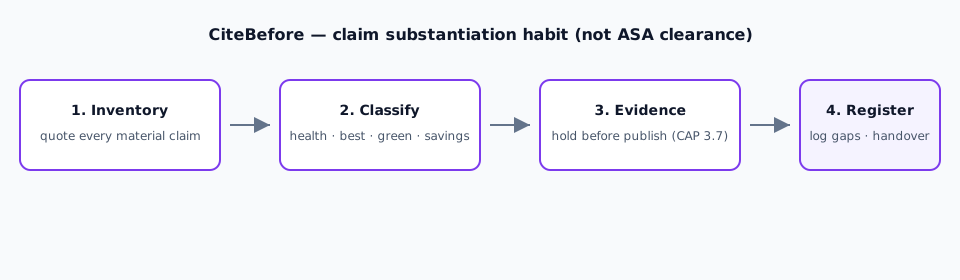
How to read a was/now line for a CiteBefore claim register
When pasting a URL or building a manual row:
- Claim text — copy the visible was/now pair exactly, including currency, inc-VAT notes, and “from” qualifiers.
- Likely consumer takeaway — e.g. “This product is genuinely £70 cheaper than its usual price on this site.”
- Evidence column — pricing history export, promotion brief, channel confirmation, post-promotion price plan.
- CAP-style note — cite rule 3.39 / promotional savings themes; flag if duration or channel looks thin on the file you hold.
Pair with superlatives and “best” claims when the sale tile also says “lowest price ever” or “best deal”. Pair with advertising claim substantiation for the savings claim class in your wider inventory.
What CiteBefore does — and does not do
Clear limits
- Not ASA clearance and not a substitute for ASA Copy Advice.
- Not legal advice and not price-comparison or consumer-law advice.
- Not “breach” coaching — we do not tell you to complain to the ASA or label a live was/now module a breach.
- CiteBefore inventories claims and suggests evidence columns. The ASA decides complaints.
Free on-screen scan · £29 PDF Claim Register · £79/mo Site Watch · £149/mo Agency
Try free scan Order £29 Register Pricing
Primary sources
- ASA/CAP AdviceOnline: Promotional savings claims
- CAP Code Section 03 — Misleading advertising (rules 3.39, 3.40)
- ASA/CAP AdviceOnline: Promotional marketing — closing dates
- Non-broadcast Advertising Code hub
FAQ
How long must the “was” price have been charged?
Published ASA materials emphasise duration and recency: the reference price should generally have been the most recent price and charged longer than the promotional price. AdviceOnline often discusses three months of pricing history. Your pricing team holds the data; CiteBefore inventories the claim text.
Does Black Friday need different evidence?
Not a separate CAP rule — but peak campaigns compress timelines. Capture reference windows, promotion end dates, and post-sale prices in your register before publish. See the Black Friday checklist above.
Can I use a store price as the online “was” price?
Published CAP materials say a reference price for an online offer should reflect the usual selling price on that same channel. This guide does not provide legal advice on omnichannel pricing — consult your advisers if unsure.
Does CiteBefore clear was/now pricing with the ASA?
No. CiteBefore inventories claims and evidence columns on a live URL. It is not ASA clearance, not Copy Advice, and not legal advice. The ASA decides complaints.
Related guides
- Advertising claim substantiation for UK landing pages
- Countdown timers in UK ads — reading CAP cues (literacy)
- Free delivery advertising claims under UK CAP — landing-page literacy
- Money-back guarantee claims on landing pages — CAP literacy
- Comparative and vs-competitor claims checklist
- Superlatives and “best” claims — logging CAP Rule 3.7 risk
- How to build a CAP-style claim register (agency template)
- All guides
Guide for UK marketers and agencies. Informational only. Author: Ellis Greensitt. datePublished 2026-09-09. Last reviewed against ASA promotional savings claims AdviceOnline as of Sep 2026.