United Kingdom · CAP Code 3.55 · guarantees & refunds
Money-back guarantee claims on landing pages — CAP literacy
Product pages, checkout trust strips, and info-product landers often promise a money-back guarantee landing page shoppers can rely on — “100% money-back guarantee”, “30-day satisfaction guarantee”, “Easy returns”. Published CAP and ASA materials treat guarantee copy as a substantiation and process question: when a hidden restocking fee, missing return address, or slow refund contradicts the headline, rules 3.53–3.55 are the literacy frame. This guide is claim-register habit — not ASA clearance, not legal advice, and not returns-policy drafting.
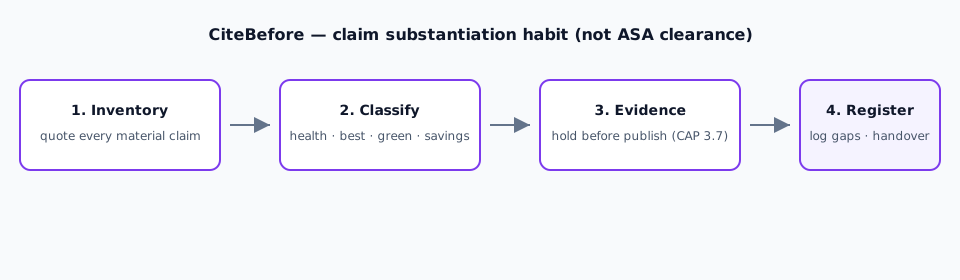
Where money-back guarantee claims appear
Guarantee copy signals trust across the purchase path. Common placements:
- Hero and trust strips — “100% Satisfaction Guarantee” badge beside the buy button.
- Product detail pages — “30-day money-back guarantee” under price modules (often adjacent to was/now savings or urgency timers).
- Checkout and order confirmation — guarantee reiterated after payment, sometimes without the limitations visible on the PDP.
- Info-product and subscription landers — “lifetime money-back guarantee” on long-form sales pages.
- Email and retargeting — cropped guarantee lines that deep-link to checkout (inventory the destination URL).
Consumers often read “100% money-back guarantee” as meaning a full refund with no hidden deductions if they are dissatisfied. Published ASA case summaries discuss when limitations buried in returns policy or customer-service practice contradict that takeaway.
What published CAP / ASA materials say about guarantees
These are themes from AdviceOnline and published ASA records — literacy only, not a ruling on your live URL.
Guarantee wording must not confuse (rule 3.53)
CAP Code section 3 includes rule 3.53: marketers must not use “guarantee” in a way that causes confusion about the consumer’s rights. For register literacy, note whether the guarantee is presented as adding to, or replacing, statutory rights — without drafting consumer-law advice.
Limitations must be clear before purchase (rule 3.54)
Rule 3.54 requires marketers to make clear each significant limitation to a guarantee and to supply full terms before the consumer is committed. AdviceOnline on guarantees and warranties discusses presenting significant conditions clearly and prominently. For inventory habit: if a restocking fee, return-window restriction, or product-use condition applies, note whether it appears before checkout or only in linked T&Cs.
Prompt refunds on valid claims (rule 3.55)
Rule 3.55 states that marketers must promptly refund consumers who make valid claims under a money-back guarantee. Published ASA materials discuss patterns such as:
- Hidden deductions — “100% Satisfaction Guarantee” alongside a £9 restocking fee deducted at refund, or an offer of partial credit instead of a refund (materials reference Orthoback Ltd, 7 August 2024, as an example in published records).
- No workable returns process — “Easy Returns” or guarantee copy without a usable return address or refund pathway (Orthoback example in published materials).
- No evidence of routine refunds — “30-Day Money Back Guarantee” without evidence consumers who claimed were routinely refunded (materials reference Velora London Ltd, 30 April 2025, as an example).
- Absolute lifetime guarantees — “100% Lifetime Money-Back Guarantee” where complainants did not receive refunds when claimed (materials reference VIP Inner Circle / Paul Coleman, 5 May 2021, as an example in published records).
This guide quotes published themes only. It does not treat ASA case summaries as legal holdings on your page, and it does not summarise Consumer Rights Act statutory refund rights.
When to soften the claim vs hold refund-process evidence
Claim-register literacy is not clearance — but teams often choose between two paths before publish:
- Hold evidence — if you keep “100% money-back guarantee”, note in the Evidence column: returns policy, restocking-fee disclosure location, refund-log showing prompt processing, and customer-service scripts for valid claims.
- Soften the claim — if limitations are material and hard to state prominently, consider “30-day returns policy” or “full refund if not satisfied (see terms)” without an absolute “100%” — inventory the revised line after edit.
CiteBefore does not draft your returns policy. It inventories what the live page says and suggests evidence columns your team should hold.
How to read a guarantee claim for a CiteBefore claim register
When you paste a URL into CiteBefore or build a manual register row:
-
Copy the exact guarantee line — “100% money-back guarantee”, “30-day satisfaction guarantee”, “Easy returns”, including badge text and footnotes.
-
Locate significant limitations — restocking fees, return windows, product-use conditions, geographic restrictions. Note visibility before checkout.
-
Write the likely consumer takeaway — e.g. “Full purchase price refunded promptly if I am not satisfied” vs “Refund minus £9 handling fee.”
-
Flag hidden-limitation risk — if “100%” appears in the hero but deductions sit in T&Cs, note rules 3.54 and 3.55 in your CAP-style column.
-
Mark evidence held or gap — returns policy URL, refund-process documentation, customer-service SLA. CiteBefore suggests evidence columns; your team holds the files.
Example register thinking (illustrative, not clearance):
- Claim: “100% money-back guarantee” → Takeaway: full refund, no deductions → Risk note: £9 restocking fee in returns policy only → CAP note: rules 3.54 / 3.55.
- Claim: “30-day money-back guarantee” → Evidence to note: refund-log showing routine prompt refunds, or gap flagged before peak trading.
The agency claim-register template shows column layout. A free scan surfaces guarantee-shaped lines; the £29 Claim Register is the file-ready PDF for client handover. Site Watch (£79/mo) re-scans product URLs when guarantee copy changes.
What CiteBefore does — and does not do
Clear limits
- Not ASA clearance and not a substitute for ASA Copy Advice.
- Not legal advice and not confirmation that a guarantee module is cleared to publish.
- Not a complaint coach — we do not tell you to report an ad to the ASA or assert that a live guarantee line is a “breach”.
- CiteBefore inventories claims and suggests evidence columns to hold. The ASA decides complaints against the CAP Code.
Free on-screen scan · £29 PDF Claim Register · £79/mo Site Watch · £149/mo Agency
Try free scan Order £29 Register Pricing
Primary sources
- ASA/CAP AdviceOnline: Guarantees and warranties
- CAP Code Section 03 — Misleading advertising (rules 3.1, 3.3, 3.53, 3.54, 3.55)
- Non-broadcast Advertising Code hub
FAQ
Can I say “100% money-back guarantee” if I deduct a restocking fee?
Published ASA materials discuss “100%” guarantee headlines alongside hidden restocking fees or partial-credit offers as misleading under rules 3.54 and 3.55. Significant limitations should be clear before purchase. This guide does not adjudicate your live page — inventory the headline and the fee disclosure together, then hold refund-process evidence or soften the absolute.
Is a satisfaction guarantee different from a money-back guarantee for CAP literacy?
For register purposes, treat both as guarantee-class claims. Inventory the exact wording, the consumer takeaway, and whether a refund or only a replacement/credit is offered. Rules 3.53–3.55 apply to guarantee copy generally.
Do customer testimonials about easy refunds substantiate the guarantee?
No. A testimonial is not substantiation for an objective guarantee claim. Inventory the quote separately under testimonials guidance and hold process evidence for the guarantee line itself.
Does CiteBefore clear guarantee copy with the ASA?
No. CiteBefore inventories claims and evidence columns on a live URL. It is not ASA clearance, not Copy Advice, and not legal advice. The ASA decides complaints.
Related guides
- Advertising claim substantiation for UK landing pages
- Testimonials are not substantiation
- Was/now pricing claims (incl. Black Friday) — reading UK CAP cues
- How to build a CAP-style claim register (agency template)
- All guides
Guide for UK marketers and agencies. Informational only. Author: Ellis Greensitt. datePublished 2026-09-14. Last reviewed against ASA guarantees AdviceOnline and published ruling themes as of Sep 2026.