United Kingdom · CAP Code 3.33–3.34 · pre-publish checklist
Comparative and vs-competitor claims checklist
“Faster than Brand X”, “#1 vs leading supermarket own-label”, “more effective than our old formula” — comparative claims need objective, like-for-like evidence before publish under CAP Code rules 3.33–3.34. This checklist is literacy only, not ASA clearance and not legal advice.
What counts as a comparative claim
Any line that invites the consumer to judge your product against another identifiable product, service, or market position:
- Named competitor (“vs [Brand]”, “beats [Retailer] own brand”).
- Unnamed but identifiable market leader (“vs the leading UK battery brand”).
- Percentage or metric superiority (“30% longer lasting”, “half the sugar of [category average]”).
- Implicit comparison (“now even more effective” when the old version is still sold).
Superlatives without a named comparator (“best”, “leading”) sit in the sibling guide superlatives and “best” claims. This page focuses on versus wording.
Before you publish — checklist
-
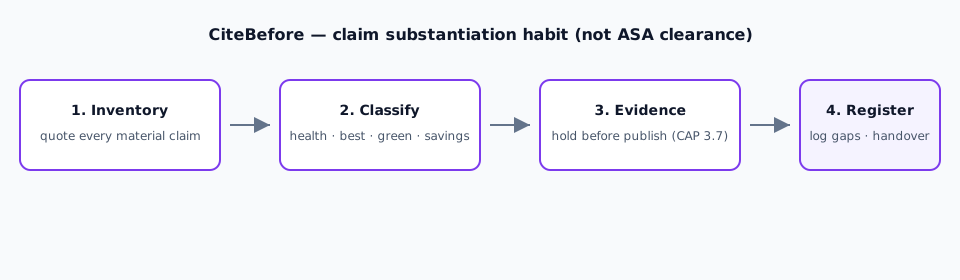
Inventory every comparative line on the live URL. Include hero, comparison tables, footnotes, badges, and recycled email modules. A free scan is quick triage; the £29 Claim Register is the file-ready inventory.
-
Name the comparator exactly as consumers will read it. If you mean “leading supermarket own-label dishwasher tablet”, say that in the register row — not a vague “competitors”.
-
Hold head-to-head substantiation. CAP expects comparisons to be objective and like-for-like: same test conditions, fair sample, relevant metric. Marketing slide decks alone are usually not enough.
-
Check the comparison is current. Competitor formulations change. Date-stamp the study and the competitor SKU you tested.
-
Mark evidence held or gap in the register. Claim · Risk · Evidence · CAP note — see the claim-register template.
-
Soften or remove before publish if the gap is material. CiteBefore flags risk; it does not clear copy. Use ASA substantiation advice and Copy Advice when you need an external view.
Common failure patterns
- Cherry-picked metric. Faster dry time in lab conditions but not the claim consumers read on the hero.
- Stale competitor data. Study from 2022 against a reformulated 2026 rival product.
- Different product class. Comparing pro-grade kit to consumer SKU without saying so.
- Visual tables without sources. Comparison grids on landing pages with no footnoted test method.
Re-scan after edits
Comparative tables are a frequent post-edit surprise. If you change hero copy or add a “vs competitor” row, re-scan the same URL — see before-and-after URL habit. Site Watch (£79/month) automates weekly re-crawls for nominated URLs.
Questions
Is “greener than our old formula” a comparative claim?
Usually yes — you are comparing to your own prior product. You still need evidence for the environmental improvement consumers will understand from the line. See also the green claims checklist.
Do I need permission from the competitor?
CAP comparisons must be fair and substantiated; they do not require competitor consent in every case, but identifiability and fairness matter. This guide does not provide legal advice on naming rivals — instruct a solicitor if unsure.
How is this different from the superlatives guide?
Superlatives (“best”, “No.1”) often lack a named comparator. This guide covers explicit versus wording and comparison tables. Both need substantiation under Rule 3.7; comparisons also engage 3.33–3.34.
Is a CiteBefore scan ASA clearance?
No. A free scan lists top risk flags on screen. The £29 register is a full inventory PDF for your files. Neither is clearance.
Informational guide only. Sources: CAP Code Section 03 (rules 3.7, 3.33–3.34). Last reviewed 10 September 2026. CiteBefore is not the ASA. See also was/now pricing claims (incl. Black Friday) when sale tiles mix reference pricing with competitor comparisons.