United Kingdom · CAP Code 8.17 · urgency & promotions
Limited time offer claims on UK landing pages — reading CAP cues
“Ends midnight”, “last chance”, “only today” and sticky-banner urgency lines are everywhere on UK e-commerce and D2C landing pages. Published CAP and ASA materials treat many of these as significant conditions on a promotion — consumers often read them as genuine time limits. This guide is claim-register literacy for limited time offer claims UK pages. Not ASA clearance. Not legal advice.
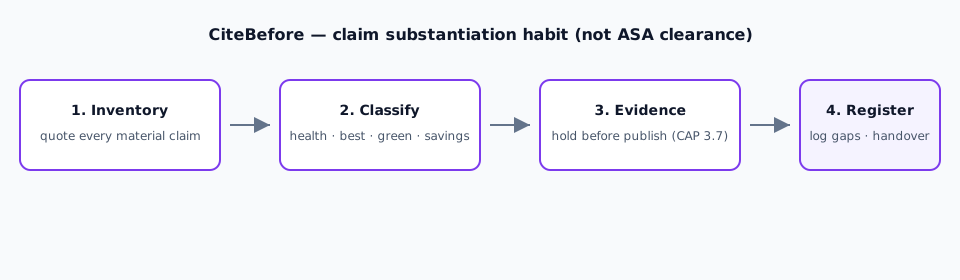
Where limited-time and urgency claims appear
Urgency copy is not only a countdown clock. Inventory every material line a shopper could read as a closing date or scarcity signal:
- Hero headlines — “Sale ends Sunday”, “48 hours only”, “Ends midnight tonight”.
- Sticky headers and cart nudges — “HURRY — offer expires in…” paired with free delivery or discount lines.
- Email-capture pop-ups — “Claim before midnight” for a first-order discount.
- PDP modules — “Price held until [date]” next to a promotional price.
- Checkout timers — discount or free-shipping clocks beside the order total.
When a module includes a ticking clock, read it alongside this guide and the dedicated countdown timer guide. Log text-only urgency as its own register row — not as decoration.
What published CAP / ASA materials say
These are themes from the Non-broadcast Code and AdviceOnline — literacy only, not a ruling on your live URL.
Significant conditions and closing dates (rule 8.17)
CAP Code section 8 requires promotions to communicate significant conditions where omission would mislead. A prominent closing date is listed as a significant condition (rule 8.17.4.a). AdviceOnline on promotional marketing closing dates explains that most promotions need a closing date, presented clearly and prominently.
Rule 8.17.4.e states that closing dates must not be changed unless unavoidable circumstances outside the promoter’s control apply, and the change would not disadvantage those who participated on the original terms. Published countdown guidance ties this to offers that restart when a timer reaches zero — treating a reset as changing a closing date outside permitted circumstances.
“Ends midnight” and absolute urgency language
Phrases like “ends midnight”, “last day”, or “final hours” create a strong consumer expectation that the offer will not continue unchanged afterward. ASA news articles The final countdown and It’s the final countdown, but is it really? summarise CAP’s published position on promotional countdowns:
- Promotions tied to urgency cues should be genuine — accompanying prices or benefits should revert when the stated period ends.
- Consumers who buy during the window often do so in good faith that the deal is time-limited.
- Words like “HURRY” alongside a deadline can reinforce the impression that the offer is genuinely short (closing dates AdviceOnline cites published case summaries).
Link to savings and reference pricing
When urgency sits beside a struck-through “was” price, inventory both rows. CAP’s promotional savings claims AdviceOnline requires reference prices to represent a genuine established usual selling price (rule 3.39). A limited-time line can imply the promotional price is temporary — pair with the was/now pricing guide.
How to inventory limited-time claims for a register
-
Copy the exact urgency text — including “ENDS MIDNIGHT”, “LAST CHANCE”, red styling if material, and any paired offer (“20% OFF”, “FREE DELIVERY”).
-
Write the likely consumer takeaway — e.g. “Offer ends at stated time; price or benefit reverts afterward; same offer will not immediately restart.”
-
Record promotion mechanics — scheduled start/end (BST/GMT), SKUs in scope, channel (site-wide vs category), and what happens after close.
-
Cross-link savings rows — if a reference price appears above the urgency line, log a separate was/now row tied to the same window.
-
Mark evidence held or gap — promotion brief, pricing history, post-close price list. CiteBefore suggests evidence columns; your team holds the files.
Common urgency patterns on UK landing pages
| On-page copy | Likely consumer takeaway | Evidence column to note |
|---|---|---|
| “Ends midnight tonight” | Offer closes end of calendar day; will not continue unchanged | Promotion end timestamp (timezone), post-midnight price plan |
| “48 hours only” / “Weekend sale” | Fixed window; benefit ends when window closes | Start/end dates, rule 8.17 significant conditions on page |
| “Last chance” / “Final hours” | Scarcity + imminent close — stronger urgency cue | Whether offer genuinely ends; prior restarts on same URL |
| “Limited time offer” (no date) | Time-limited but date unclear — significant condition risk | Whether closing date is stated prominently elsewhere on page |
| Evergreen “Sale” tab with rotating urgency | May read as perpetual promotion — check reference pricing | Pricing history, usual selling price substantiation (rule 3.39) |
What CiteBefore does — and does not do
Clear limits
- Not ASA clearance and not a substitute for ASA Copy Advice.
- Not legal advice and not confirmation that urgency copy is cleared to publish.
- CiteBefore inventories claims and suggests evidence columns to hold. The ASA decides complaints against the CAP Code.
Free on-screen scan · £29 PDF Claim Register · £79/mo Site Watch · £149/mo Agency
Try free scan Order £29 Register Pricing
Primary sources
- ASA/CAP AdviceOnline: Promotional marketing — closing dates
- ASA/CAP AdviceOnline: Promotional savings claims
- ASA: It’s the final countdown, but is it really?
- ASA: The final countdown
- CAP Code Section 08 — Sales promotions (rules 8.17, 8.17.4.e)
- CAP Code Section 03 — Misleading advertising (rule 3.1, 3.39)
FAQ
Does “ends midnight” always need a real closing time?
Published CAP materials treat a prominent closing date as a significant condition on most promotions. “Ends midnight” creates a strong expectation the offer closes at that time. This guide does not adjudicate your live page — inventory the line and note the scheduled end and post-close plan in your register.
Should I log urgency text separately from the discount?
Yes. The discount percentage and the urgency line create different consumer takeaways. Log each material line on the register, then tie related rows in your Evidence notes.
Does CiteBefore clear limited-time copy with the ASA?
No. CiteBefore inventories claims and evidence columns on a live URL. It is not ASA clearance, not Copy Advice, and not legal advice. The ASA decides complaints.
How is this different from the countdown timer guide?
The countdown timer guide covers ticking-clock modules. This page covers text-only urgency (“ends midnight”, “last chance”, “limited time”) and how to inventory it under the same promotional-marketing habits.
Related guides
- Countdown timers in UK ads — reading CAP cues
- Was/now pricing claims (incl. Black Friday) — reading UK CAP cues
- Advertising claim substantiation for UK landing pages
- Free delivery advertising claims under UK CAP
- How to build a CAP-style claim register (agency template)
- All guides
Guide for UK marketers and agencies. Informational only. Author: Ellis Greensitt. datePublished 2026-09-21. Last reviewed against ASA promotional-marketing materials as of Sep 2026.