United Kingdom · B2B SaaS · CAP Code 3.7
“Industry leading” and “trusted by X companies” — SaaS claims inventory under CAP
B2B SaaS homepages ship fast: a hero “industry leading platform”, a logo wall, a customer count pulled from CRM. Account leads assume business audiences read marketing colour — but CAP still tests likely interpretation, and unqualified leading lines often need documentary evidence under rule 3.7. This guide is a practical inventory habit for logging those claims on one live URL — not ASA clearance, not enterprise governance software.
SaaS teams recycle the same three claim types: market-position superlatives, customer-count social proof, and review-badge strips. Each can be an objective row in a claim register if consumers read it as a checkable fact. Below is where they hide, what CAP expects, and a four-pass habit before the next paid-media push.
What CAP expects for “leading” and “industry leading”
Rule 3.7 of the CAP Code requires documentary evidence before publish for objective claims consumers are likely to regard as substantiation-capable. CAP’s AdviceOnline note on leading claims and substantiation matter on SaaS pages:
- Unqualified “leading” is often understood as best-selling (unit sales and/or market share) unless another meaning is made clear.
- “Industry leading”, “market leader”, and “#1 for [category]” imply superiority across an identifiable comparison set — geography, segment, product type, and timeframe must match what the page suggests.
- Evidence must relate to your product and the competitors in scope, not internal KPIs the consumer never sees.
- B2B context does not automatically make a line puffery — see puffery vs objective claim.
The CPD Standards Office “UK’s leading body” ruling (ASA A25-1322754, 2025) is the recent B2B reminder: own-position marketing copy and internal satisfaction data are not a substitute for comparison evidence against the whole identifiable market. SaaS homepages face the same shape of problem with “leading platform for compliance teams” lines.
“Trusted by X companies” — define the set or drop the number
Customer-count claims look softer than “No.1” but still fail when the number does not match the definition consumers take from the line:
- Paying customers vs free trials vs newsletter subscribers vs pilot accounts — write the definition before publish.
- “Trusted by regulated teams” or “trusted by NHS trusts” implies a specific population; a generic logo wall does not prove it.
- Logo permissions are a separate compliance job — a logo strip is not substantiation for a separate “leading” headline unless the headline is only “these brands use us” with accurate scope.
Pair with testimonials are not substantiation when quotes sit under the count. The objective claim inside the social-proof module still needs its own evidence row.
Where SaaS claims hide on a live URL
Do not stop at the H1. Walk pricing, security, and integration subpages linked from the homepage — performance marketing often lands on /pricing with a denser claim set:
- Hero and subhead (“The industry leading …”, “#1 rated for …”).
- G2, Capterra, TrustRadius badges — read the category label and date on the asset; “High performer” is not “No.1”.
- Logo walls and “trusted by 10,000+ teams” counters fed from product analytics.
- Comparison tables vs “legacy tools” or unnamed rivals — see comparative vs competitor claims.
- Security/compliance strips (“trusted by Fortune 500”, “leading UK banks”) — high-risk rows for financial and regulated audiences.
- Footer recycling of the same superlative from last year’s funding announcement.
If the same “leading” claim appears three times, log three rows or one row with locations noted — but do not drop badge copy because “legal already saw the hero.”
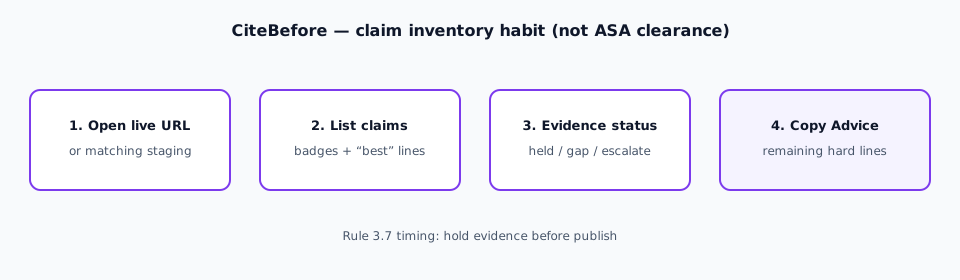
A four-pass inventory for SaaS homepages
-
Open the live URL (and /pricing if ads land there). Capture URL, go-live date, and who owns market data.
-
List every leading / trusted-by / customer-count line — including review badges and investor-deck copy pasted into the hero.
-
Define comparison set or population for each row (UK SaaS? HR tech? SMB vs enterprise? paying customers only?). Note likely consumer takeaway in plain English.
-
Mark evidence status — held / gap / Copy Advice candidate. Close gaps, qualify, or soften before publish. See superlatives / best claims for evidence types.
Evidence that usually matters for SaaS market-position claims
- Leading / market leader — contemporaneous third-party market-share or revenue data covering the category and geography implied on the page, or a clearly defined and substantiated metric (e.g. active paying seats in UK mid-market HR) held before go-live.
- Review badges — screenshot or licence terms showing category, date, and geography; do not upgrade “Leader spring 2026” into “best in the world.”
- Customer counts — export definition, date stamp, and audit trail matching “companies”, “teams”, or “users” as written.
- Comparison tables — like-for-like feature tests and dated competitor captures under rules 3.33–3.34.
For the wider claim-class map, use advertising claim substantiation. For the puffery escape hatch — narrow on product-led SaaS pages — use puffery vs objective claim.
What CiteBefore does — and does not do
Clear limits
- Not ASA clearance and not a substitute for ASA Copy Advice.
- Not legal advice and not FCA promotions clearance for regulated fintech copy.
- CiteBefore inventories claims on a URL and suggests evidence columns — the £29 Claim Register sample shows the file-ready PDF shape.
- Not enterprise ad-compliance workflow software — a cheap pre-flight register for agencies shipping client SaaS pages.
Try free scan Register sample Vs ASA Copy Advice
Primary sources
- CAP Code Section 03 — Misleading advertising (rule 3.7)
- Types of claims: leading
- Substantiation
- Comparisons: general
- Types of claims: general
FAQ
Is “industry leading” always an objective claim on a SaaS homepage?
Often yes when consumers are likely to read it as a market-position or superiority fact. CAP AdviceOnline on leading claims treats many unqualified leading lines as objective comparisons that need evidence relating to your product and the competitors in scope under rule 3.7 — not puffery by default because the page is B2B.
What evidence do I need for “trusted by 10,000 companies”?
Define the set in writing: paying customers vs free trials vs newsletter sign-ups vs pilots. The number must match the definition consumers take from the line. Undated logo walls without permission evidence are separate rows — customer logos are not substantiation for a separate superiority claim.
Does CiteBefore clear SaaS leading claims with the ASA?
No. CiteBefore inventories claims and evidence columns on a live URL. It is not ASA clearance, not Copy Advice, and not legal advice. See CiteBefore vs ASA Copy Advice.
Where do industry leading claims hide on SaaS pages?
Hero headlines, G2/Capterra badge strips, pricing-page social proof, comparison tables, investor-deck copy recycled on the homepage, and footer lines such as “the UK’s leading platform for X”. Inventory each location — do not assume legal saw the hero so the badge strip is fine.
Who writes these CiteBefore guides?
Ellis Greensitt, sole trader, trading as CiteBefore. English law. See terms and privacy. Email hello@citebefore.co.uk. No telephone.
Related guides
- Superlatives and “best” claims — CAP Rule 3.7
- Puffery vs objective claim on landing pages
- Comparative and vs-competitor claims checklist
- How to build a CAP-style claim register
- CiteBefore vs ASA Copy Advice
Guide for UK marketers and agencies. Informational only. Author: Ellis Greensitt. datePublished 2026-09-23. Last reviewed against ASA AdviceOnline leading-claims and substantiation materials as of Sep 2026.