United Kingdom · CAP Code 3.2 / 3.7 · landing pages
Puffery vs objective claim — how a hero line gets read under CAP 3.2 / 3.7
The creative brief said “make it punchy — it’s obviously puffery.” The complaint said consumers treated it as a measurable network-quality fact. Under the CAP Code, likely interpretation beats private intention. This guide is a practical split for UK marketers inventorying hero lines, trust strips, and recycled headlines on one live URL — not ASA clearance.
Teams ship landing pages faster than anyone files the evidence pack. The puffery/objective split is where many disputes start — because the same adjective reads as harmless colour to the brand and as a checkable fact to the ASA. Below is a working inventory habit with primary CAP sources.
Two rules, two jobs
CAP Section 03 on misleading advertising draws a line marketers must log on every material line:
- Rule 3.2 — obvious exaggerations (“puffery”). Claims consumers are unlikely to take literally, and subjective claims that do not contain a comparative element, may fall here. No substantiation file required when the line genuinely stays on the puffery side.
- Rule 3.7 — substantiation. Before publishing, hold documentary evidence for claims consumers are likely to regard as objective and capable of objective substantiation. See the sibling guide advertising claim substantiation and superlatives / best claims for the inventory columns.
CAP’s AdviceOnline note on puffery and expressions of opinion and types of claims: general repeat the test: context, prominence, and what reasonable consumers take from the line — not what the copywriter meant in the brief.
When “we meant puffery” still fails
Official rulings are useful because they show intention is not a defence:
- Sky “the perfect network” (8 Jun 2022) — Sky argued the line was obvious exaggeration. The ASA treated it as an objective superiority claim about network quality that needed substantiation. A hero superlative on a telecoms or SaaS landing page is not automatically puffery because the team labelled it “brand voice.”
- Ticketmaster “best available tickets” — comparative availability language consumers read as a factual promise about what they would receive, not colourful opinion.
- Qinux TitanPG (Nov 2024) — extreme product claims with no evidence held; useful as a reminder that “no file at all” fails regardless of puffery arguments.
Quotation marks, “users say”, and testimonial framing do not magically convert an objective line into opinion. If the takeaway is still “this product beats others on X”, log it as a 3.7 row. See testimonials are not substantiation.
Questions to ask on a live URL
For each hero, subhead, badge, and footer trust line, write the claim text and answer:
-
Would a reasonable consumer treat this as checkable? Rankings, speeds, prices, market share, clinical outcomes, and “perfect / flawless / unmatched” performance often read as facts.
-
Is there a comparison set implied? “Leading”, “best”, “No.1”, “cheaper than rivals” — even without naming a competitor — can be objective comparatives. See comparative vs competitor claims.
-
Does context make exaggeration obvious? Classic puffery tends to be vague, hyperbolic, and not tied to a measurable endpoint (“the most delicious experience ever”) on pages where consumers expect marketing colour — but product landing pages with spec-led layouts narrow that escape hatch.
-
Does the same idea repeat in badges or schema snippets? One puffery argument on the hero fails if the trust strip repeats the line as a ranked fact.
Examples that usually land on each side
Context always matters — these are triage prompts, not clearance labels:
- Often puffery (if truly vague): “Your new favourite Tuesday treat” on a confectionery gift page; “We love what we do” in an about strip; obvious hyperbole with no measurable endpoint.
- Often objective (evidence required): “UK’s fastest checkout” on a SaaS pricing page; “Clinically proven to reduce wrinkles in 14 days”; “Save 40% vs last year’s price”; “Perfect for sensitive skin” when tied to a test endpoint; “Award-winning” without naming the award body and date.
- Borderline — log and escalate: “Revolutionary platform”, “game-changing analytics”, “world-class support”. Teams assume puffery; ASA decisions turn on layout, category norms, and whether consumers expect proof.
When borderline, softening copy or holding evidence is safer than betting on the puffery defence. Escalate contested lines to ASA Copy Advice or a solicitor — see when inventory stops and Copy Advice starts.
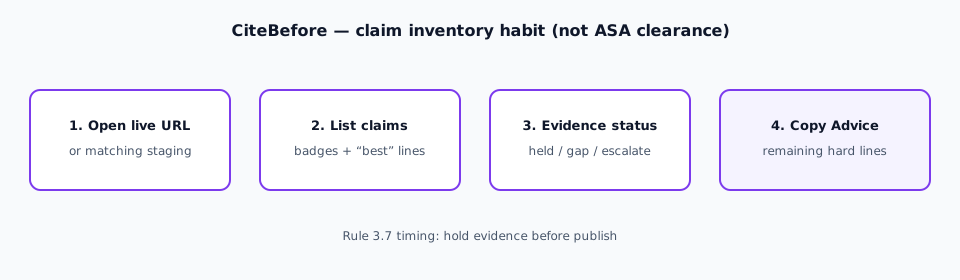
A four-pass inventory for hero lines
-
Open the live URL (or staging that matches go-live). Capture URL, publish date, and evidence owner.
-
List every material line — hero, bullets, badges, comparison cards, footer trust copy.
-
Classify puffery vs objective using likely takeaway in plain English. When in doubt, treat as objective for register purposes.
-
Mark evidence status on objective rows — held / gap / Copy Advice candidate. Close gaps or soften before publish.
What CiteBefore does — and does not do
Clear limits
- Not ASA clearance and not a substitute for ASA Copy Advice.
- Not legal advice and not a ruling that your hero line is puffery.
- CiteBefore inventories claims and suggests evidence columns. The ASA decides complaints.
Try free scan Claim-register template Vs ASA Copy Advice
Primary sources
- CAP Code Section 03 — Misleading advertising (rules 3.2, 3.7)
- Puffery and expressions of opinion
- Types of claims: general
- Substantiation
FAQ
What is the difference between puffery and an objective claim under CAP?
Puffery is obvious exaggeration or clear opinion that consumers are unlikely to take literally — covered by CAP rule 3.2. An objective claim is one consumers are likely to regard as a factual, measurable statement capable of substantiation — rule 3.7 applies and documentary evidence must be held before publish. The ASA tests likely interpretation, not the copywriter’s private intention that a line was colourful marketing.
Can quotation marks make a superiority claim puffery?
Not reliably. Framing a line as a user quote or putting it in quotation marks does not automatically convert an objective superiority claim into puffery. If consumers are still likely to read it as a factual ranking or performance statement, rule 3.7 substantiation still applies.
Does CiteBefore decide whether my hero line is puffery?
No. CiteBefore inventories claims on a live URL and marks evidence columns. It is not ASA clearance, not Copy Advice, and not legal advice. See CiteBefore vs ASA Copy Advice.
What should I log first on a landing page with a bold hero claim?
Open the live URL, write the hero line verbatim, note the likely consumer takeaway in plain English, then classify: obvious exaggeration (puffery row) or measurable fact you would need to prove (objective row under 3.7). Repeat for trust strips and footers that reuse the same idea.
Who writes these CiteBefore guides?
Ellis Greensitt, sole trader, trading as CiteBefore. English law. See terms and privacy. Email hello@citebefore.co.uk. No telephone.
Related guides
- Superlatives and “best” claims — CAP Rule 3.7
- Advertising claim substantiation for UK landing pages
- “Industry leading” and “trusted by” SaaS claims
- Testimonials are not substantiation
- CiteBefore vs ASA Copy Advice
Guide for UK marketers and agencies. Informational only. Author: Ellis Greensitt. datePublished 2026-09-23. Last reviewed against ASA AdviceOnline puffery and substantiation materials as of Sep 2026.