United Kingdom · CAP Code 3.7 · trust & awards
Trust badges and award claims on UK landing pages — CAP 3.7 literacy
Trustpilot widgets, “award-winning”, “as seen in” logo strips, and certification badges look like design chrome. On UK landing pages, consumers often read them as objective claims about quality, ranking, or endorsement. Under CAP Code 3.7, marketers must hold substantiation for claims consumers are likely to regard as objective. This guide teaches claim-register inventory for trust badge advertising UK pages — not ASA clearance. Not legal advice.
Where trust badges and award claims appear
Inventory every badge, logo strip, and endorsement line — not only headline copy:
- Hero trust strips — “Award-winning”, “#1 rated”, “Trusted by 50,000 customers” above the fold.
- Review platform widgets — Trustpilot, Feefo, Google Reviews stars with aggregate scores.
- “As seen in” / “Featured in” rows — media logos (BBC, Guardian, Vogue) without context.
- Certification and scheme badges — B Corp, ISO, organic, dermatologist-tested seals, payment trust marks.
- Professional endorsement lines — “Dermatologist recommended”, “Pharmacist approved”, “Used by NHS trusts” (high scrutiny — see the dedicated dermatologist recommended guide).
- Footer clusters — small logos easy to miss in a manual review but visible to consumers sitewide.
What CAP Code 3.7 requires (badges included)
Rule 3.7 of the CAP Code (Misleading advertising — Substantiation) requires marketers to hold documentary evidence before publication for claims consumers are likely to regard as objective and capable of objective substantiation.
CAP’s AdviceOnline note on substantiation stresses that the ASA looks at the likely interpretation of a claim, not the marketer’s private intention. A badge meant as “trust decoration” can still be treated as an objective claim if shoppers read it that way.
Related rules when badges imply ranking or comparison:
- Superlatives and “best” — see superlatives and “best” claims guide.
- Comparisons — “vs competitors”, “leading brand” need competitor-scope evidence (Comparisons: general).
- Testimonials inside widgets — quotes do not substantiate objective claims; see testimonials are not substantiation.
Inventory checklist by badge type
Review scores and star widgets
Aggregate star ratings (“4.8/5 from 2,000 reviews”) are often read as objective quality claims. CAP allows genuine testimonials, but they alone are unlikely to substantiate separate objective efficacy or performance claims (substantiation advice).
- Log the exact score, review count, platform, and date range shown on-page.
- Hold evidence the widget reflects genuine, current reviews on that platform — not a static screenshot from launch week.
- Inventory any text inside the widget (“best moisturiser I’ve used”) as its own claim row.
- Do not use review widgets to support separate “clinically proven” or “No.1” headline claims without appropriate evidence class.
“Award-winning” and trophy claims
“Award-winning”, “winner of [prize]”, and trophy icons imply a specific, verifiable accolade. Hold:
- The named award, awarding body, year, and category.
- Proof your product or company won (certificate, press release, organiser confirmation).
- Scope — UK vs global, product SKU vs parent brand, dated award vs evergreen badge on a 2026 page.
“Industry award-winning” without naming the award is higher ambiguity — log the likely consumer takeaway and note the gap.
“As seen in” and media logo strips
Media logos create an implied endorsement or feature claim. CAP’s substantiation principles apply when consumers are likely to read the strip as “featured/recommended by [publication]”.
- Hold the actual clip, article, broadcast segment, or paid/partnership disclosure that matches the logo.
- Distinguish editorial coverage from paid placement — if it was an advertorial, the consumer takeaway may differ.
- Log each logo separately if the strip mixes outlets with different evidence bases.
Certification and scheme badges
Certification badges (organic, cruelty-free, carbon neutral, payment security marks) are often read as absolute or scheme-backed claims:
- Name the scheme, standard, certificate number, and validity period.
- Document scope — which SKU, site, or company entity is covered.
- For environmental badges, cross-read the green claims checklist.
- Payment trust marks (Visa Secure, etc.) — hold current merchant compliance; do not display expired scheme artwork.
Register row examples (illustrative, not clearance)
| On-page element | Likely consumer takeaway | Evidence column to note |
|---|---|---|
| Trustpilot 4.9★ widget | Highly rated by many verified customers | Platform export, date, genuine review policy, score matches live widget |
| “Award-winning skincare” | Won a named, recent industry award | Award name, body, year, category, winner confirmation |
| BBC + Guardian logo strip | Featured or endorsed by those outlets | Clip URL, date, editorial vs paid, permission if required |
| “No.1 dermatologist recommended” badge | Objective market leadership claim | Survey method, sample, date — see dermatologist guide |
| B Corp logo in footer | Company meets B Corp certification standard | Current certificate, certified entity name matches trading brand |
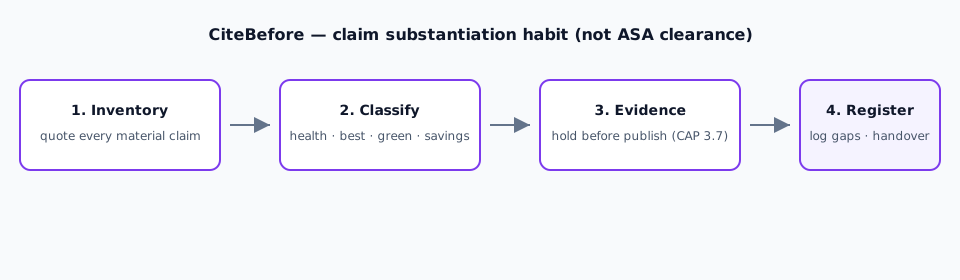
Four-pass habit for badge-heavy pages
-
Above-the-fold sweep — hero badges, star widgets, “best/No.1” lines. See superlatives guide.
-
Mid-page modules — comparison tables with tick marks, “as seen in”, partner logos.
-
Footer and checkout — small certification marks, payment badges, guarantee seals (money-back guarantee guide).
-
Re-scan after edits — badge swaps are common in CRO tests. Same URL, new claim set — see before-and-after URL guide.
The agency claim-register template shows column layout. Run a free scan for a starting inventory or order the £29 Claim Register for client handover.
What CiteBefore does — and does not do
Clear limits
- Not ASA clearance and not a substitute for ASA Copy Advice.
- Not legal advice and not confirmation that a badge is cleared to publish.
- CiteBefore inventories claims and suggests evidence columns to hold. The ASA decides complaints against the CAP Code.
Free on-screen scan · £29 PDF Claim Register · £79/mo Site Watch · £149/mo Agency
Try free scan Order £29 Register Pricing
Primary sources
- CAP Code Section 03 — Misleading advertising (rule 3.7)
- ASA/CAP AdviceOnline: Substantiation
- Comparisons: general
- Types of claims: general
- Testimonials
- Non-broadcast Advertising Code hub
FAQ
Are trust badges always advertising claims?
Not every badge is an objective claim — clear puffery and obvious opinion can fall outside 3.7 in some contexts. On product landing pages, badges and “award-winning” lines are often read as factual. Inventory each element and note the likely consumer takeaway; this guide does not adjudicate your live URL.
Can I use a Trustpilot widget instead of holding study evidence?
Genuine review widgets may appear in ads, but CAP advises testimonials and reviews alone are unlikely to substantiate separate objective efficacy or performance claims. Log the widget for what it says (aggregate score) and hold separate evidence for headline claims like “clinically proven”.
Do “as seen in” logos need evidence?
When consumers are likely to read a media logo strip as editorial feature or endorsement, treat it as a claim that needs substantiation — hold the clip or documentation that matches each logo.
Does CiteBefore clear badge copy with the ASA?
No. CiteBefore inventories claims and evidence columns on a live URL. It is not ASA clearance, not Copy Advice, and not legal advice. The ASA decides complaints.
Related guides
- Advertising claim substantiation for UK landing pages
- Superlatives and “best” claims — CAP Rule 3.7
- Testimonials are not substantiation
- “Dermatologist recommended” and professional badges
- How to build a CAP-style claim register (agency template)
- All guides
Guide for UK marketers and agencies. Informational only. Author: Ellis Greensitt. datePublished 2026-09-21. Last reviewed against ASA substantiation materials as of Sep 2026.